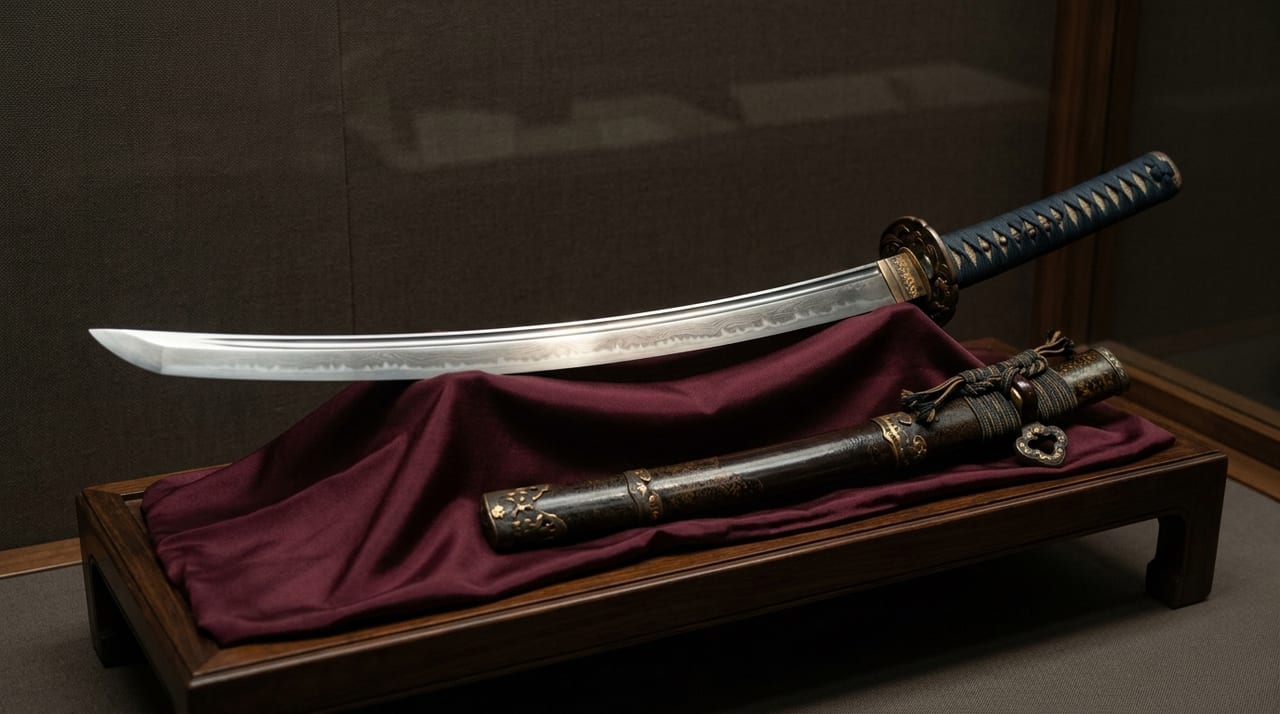
 * Image is for illustrative purposes only.
Tachi by Enju Kuniyoshi
太刀 銘 国吉(延寿国吉)
Also known as: Enju Kuniyoshi — the sleeping sword of Kasuga Grand Shrine, Higo Enju school tachi discovered in 2016
Description
The Tachi by Enju Kuniyoshi is a long cavalry sword from the late Kamakura period, forged by Kuniyoshi of the Enju school, a tradition established in Higo Province (modern Kumamoto) by Kunimura — said to be a grandson of the Yamashiro Rai school's Kuniyori — who worked under the patronage of the Kikuchi clan. Kuniyoshi is believed to have been Kunimura's son, and his work is known for the refined, elegant style inherited from the Rai lineage.
In December 2016, this blade — approximately 107 cm long and signed "Kuniyoshi" on the tang — was discovered in the ceiling of a treasure storehouse at Kasuga Grand Shrine in Nara, where it had lain virtually unpolished for 77 years. A medieval sword preserving nearly all its original Kamakura-period polishing is extraordinarily rare, and the discovery was recognized as an exceptional find for sword research.
After restoration by Living National Treasure sword polisher Honami Koshu, researcher Sakai Motoki of the Tokyo National Museum declared the sword "not inferior to a national treasure." It is believed to have been dedicated to Kasuga Shrine by Hojo Tokimura, who served as Rokuhara deputy commissioner in 1283, suggesting a connection to the Kamakura shogunate. Historical records also document that the 6th Ashikaga shogun Yoshinori prized a sword by Enju Kuniyoshi.
The blade exemplifies the Enju school's Rai-derived style: refined ko-itame and masame grain, bright white ji-hada, and a gentle suguha hamon with subtle activity — an elegant, dignified style beloved by both courtiers and warriors, in contrast to the bold swords of the Nanbokucho era that followed. Now held and displayed at Kasuga Grand Shrine, it is celebrated among sword enthusiasts as the "sleeping sword that time forgot."
Legends & Stories
Known as a modern legend of the "sleeping sword" — hidden in the ceiling of Kasuga Grand Shrine's treasure house for about 77 years before its discovery in 2016, the blade retained nearly all its medieval polishing, as if awakening from centuries of slumber.