New Arrivals — Browse our catalog for the latest authentic Japanese sword arrivals. Browse →
17th day of the 11th month, Kōan 8 (1285)
Kamakura (present-day Kamakura, Kanagawa Prefecture)
Forces
Yoritsuna Faction (Tokusō Steward)
Yasumori Faction (Senior Gokenin)
About 11 min read
The Shimotsuki Disturbance was a political upheaval in which, on the 17th day of the 11th month of Kōan 8 (1285), Adachi Yasumori, a gokenin of the Kamakura Shogunate, was destroyed along with his entire clan by Taira no Yoritsuna, the internal administrator. “Shimotsuki” is an alternate name for the 11th month of the lunar calendar, and the incident was named after the month in which it occurred. This coup is recorded in history as a major incident that solidified the autocratic rule of the Hōjō Tokusō family, deepened the division of gokenin society, and formed a distant cause of the decline of the Kamakura Shogunate.
After the death of Hōjō Tokimune, the eighth regent, the Kamakura Shogunate experienced rapid internal division. Tokimune was a heroic leader who repelled the Kōan campaign of Kōan 4 (1281), the second Mongol invasion, but he died suddenly in Kōan 7 (1284) at the young age of 34. His successor, Hōjō Sadatoki, the ninth regent, was still only 14 years old, and real power was held by Adachi Yasumori, Sadatoki's maternal grandfather, and Taira no Yoritsuna, the steward (internal administrator) of the Hōjō Tokusō family.
Adachi Yasumori promoted a political reform known as the “Kōan Virtuous Administration,” which sought to resolve the economic distress faced by gokenin after the Mongol invasions and to check the autocracy of the Tokusō family. This reform, which aimed to resolve territorial disputes and restore the status of gokenin, was supported by a broad range of gokenin, but it was fundamentally incompatible with Taira no Yoritsuna, who sought to strengthen the power of the Tokusō family.
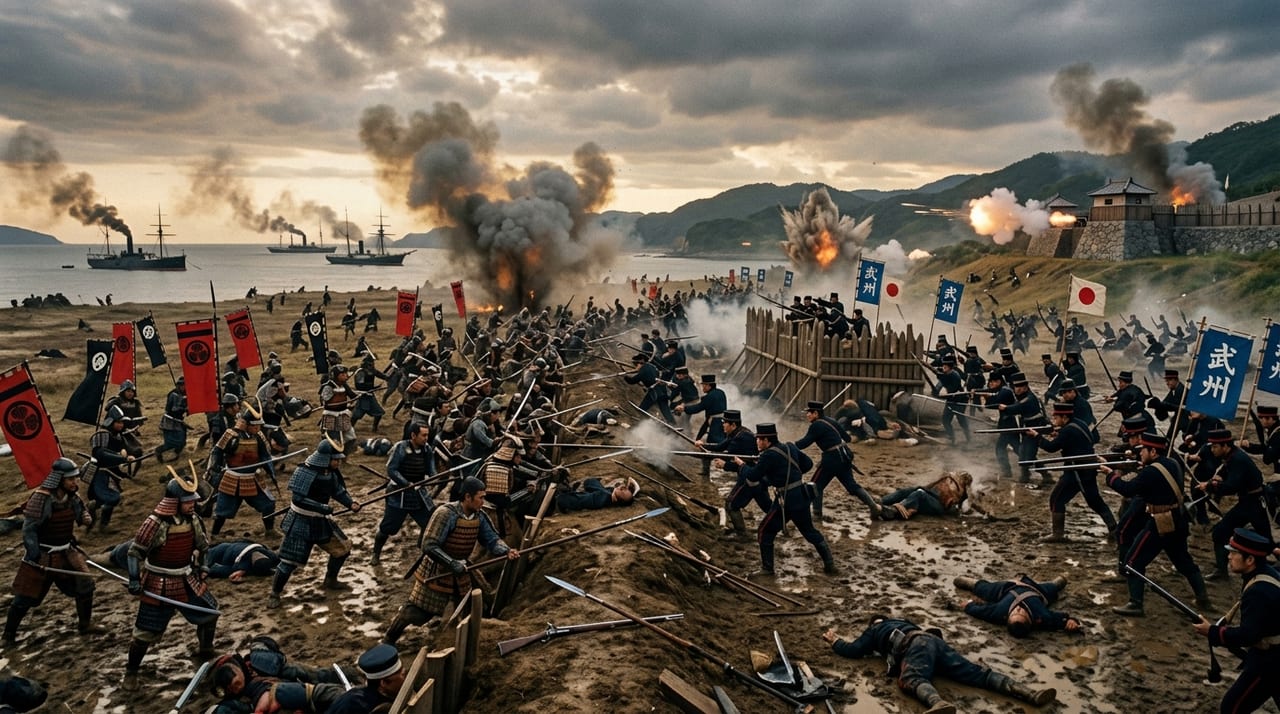
On the 17th day of the 11th month of Kōan 8 (1285), Taira no Yoritsuna accused Adachi Yasumori of rebellion before Hōjō Sadatoki and attacked the Adachi clan with the forces of the shogunate. The Adachi clan, which was attacked first by Yoritsuna's side, resisted fiercely, but Yasumori and his eldest son Munekage, among others, were killed. It is said that more than 500 members of the Adachi clan and gokenin implicated with them were killed in battle or executed on this occasion, and it is recorded that the streets of Kamakura were stained with blood in a single day.
Yoritsuna seized the territories of the Adachi clan and dissolved its retainer forces. Thus the Adachi clan, one of the most powerful forces among the gokenin, was destroyed overnight, and Taira no Yoritsuna became the de facto dictator of the shogunate.
The Shimotsuki Disturbance also holds significance for considering the role of swords in the Kamakura period. The Kamakura period was a time when Japanese sword-making techniques developed rapidly, and first-rate smiths were active, centered on Bizen and Yamashiro. The Rai school, the Osafune school, the Awataguchi school, and others competed to forge famous swords, and gokenin competed to obtain them.
A gokenin's sword was not merely a weapon but a symbol of family rank and authority, and it was also used as a gift when forming lord-vassal ties.
In Bizen around the time of the Shimotsuki Disturbance, Nagamitsu of the Osafune school was active, and his son Kagemitsu and others succeeded him.
After the Shimotsuki Disturbance, Taira no Yoritsuna wielded enormous power within the shogunate. However, his arbitrary conduct, which went beyond his position as steward of the Tokusō family, did not last long. In Shōō 6 (1293), Yoritsuna was also punished by Hōjō Sadatoki (the Heizenmon no Ran). Sadatoki, wary of Yoritsuna's arbitrary conduct, attacked him, triggered by a secret report from Yoritsuna's eldest son, Munetsuna.
Thus, through the series of political upheavals from the Shimotsuki Disturbance to the Heizenmon no Ran, the power structure of the Kamakura Shogunate was greatly transformed. The Tokusō autocracy was established, but the shogunate, having lost the support of a broad range of gokenin, gradually lost the basis of its legitimacy.
The Shimotsuki Disturbance holds significance in Japanese history in the following respects.
First, this coup accelerated the establishment of the Tokusō autocratic system. With the disappearance of the Adachi family, a powerful opposing force among the gokenin, the power of the Hōjō Tokusō family became unrivaled. At the same time, however, it paid the price of losing the cohesion of the broad base of gokenin who supported the shogunate.
Second, it became an occasion for the exhaustion and discontent of gokenin society after the Mongol invasions to erupt. The collapse of the “Kōan Virtuous Administration” promoted by Adachi Yasumori cut off the gokenin's hopes for political relief and accumulated their discontent with the shogunate. This pent-up discontent later became a distant cause of the movement to overthrow the shogunate.
Third, this incident demonstrated the danger of “gekokujō” (the rise of inferiors over superiors) in warrior society. The fact that Taira no Yoritsuna, a vassal in the position of an internal administrator, seized power equal to that of his lord's house, and further destroyed the Adachi clan, a maternal relative of the Tokusō family, was an event that shook the foundations of the lord-vassal relationship.
Half a century after the Shimotsuki Disturbance, in Genkō 3 (1333), the Kamakura Shogunate fell as a result of Emperor Go-Daigo's movement to overthrow the shogunate and Nitta Yoshisada's attack on Kamakura. Historians position the Shimotsuki Disturbance as one of the distant causes of this fall. The division of gokenin society, resentment toward the Tokusō autocracy, and economic distress after the Mongol invasions acted in combination to bring about the collapse of the shogunate, and the Shimotsuki Disturbance was an event at the beginning of that chain.
Even today the Shimotsuki Disturbance is positioned as an important incident in the study of Kamakura-period history, and it is an indispensable source and subject of research in the study of the power structure of the Kamakura Shogunate and the gokenin system. Including the sword culture behind it, this political upheaval is a historical mirror that deeply illuminates the essence of warrior society.