New Arrivals — Browse our catalog for the latest authentic Japanese sword arrivals. Browse →
寛永14年~15年(1637年~1638年)
肥前国島原半島・天草諸島(現・長崎県島原市、天草市周辺)
Forces
Peasant and ronin forces from Shimabara and Amakusa
Tokugawa shogunate and regional daimyo forces
About 12 min read
The Shimabara-Amakusa Rebellion stands as the largest peasant uprising of the Edo period and simultaneously the most dramatic armed rebellion born of religious and social oppression in Japanese history. The event became a crucial trial of the Tokugawa shogunate's consolidation of power, and its suppression brought about irreversible historical transformations.
**The Social Background**
The Shimabara Peninsula and Amakusa Islands were regions where Christian faith had taken deep root since the Sengoku period. Spanish and Portuguese missionaries arrived in Japan from the mid-sixteenth century, and numerous daimyo in southwestern Kyushu converted to Christianity, with the faith spreading among their subjects. Even after Toyotomi Hideyoshi banned Christianity, the faith persisted underground in this region.
By the early Kanei era (1620s–30s), the shogunate under Tokugawa Iemitsu began implementing Christian proscription more rigorously. Concurrently, nationwide pressure on peasant taxation increased. The lord of Shimabara Domain in Hizen Province, Matsudaira Tadafusa, imposed crushing levies on his subjects. Peasant burdens reached a breaking point, and the system of "nenki hōkō" (year-contract labor bondage)—where peasants performed debt-labor for period determined by the lord—became more strictly enforced, rendering peasant conditions desperate. Adding to this were the lord's poor responses to famine and popular resentment over temple-and-shrine tax collection. Christian faith became a psychological bulwark against such oppression and injustice, maintaining robust standing as a folk belief.
**The Outbreak — Amakusa Shirō and the Uprising**
The central figure in the event was Amakusa Shirō, a mere sixteen years old. Born the son of a minor village headman in the Amakusa Islands, he had received Christian baptism in childhood and was, by some accounts, raised as a missionary's foster child. Young Shirō displayed uncommon talent unusual for peasant society, and uneducated farmers began to regard him as "Christ's child" or "a messenger from Heaven."
In October 1637 (Kan'ei 14), responding to Matsudaira Tadafusa's crushing tax collection and Christian persecution, peasants in the Amakusa region rose in rebellion. Initially limited in scope, the uprising rapidly spread to neighboring areas, with peasants on the Shimabara Peninsula rising in sympathy. Within weeks, participation swelled from thousands to tens of thousands. Rebel forces initially targeted local shogunal administrative structures (magistrate's offices, village headmen's headquarters), seeking to overturn local authority through the destruction of symbols of domain power. But recognizing the scale of events, the shogunate launched a nationwide mobilization, concentrating approximately 150,000 troops in the Shimabara region—a scale of military mobilization comparable to the largest campaigns of the Sengoku period.
**The Siege of Hara Castle and 100 Days of Resistance**
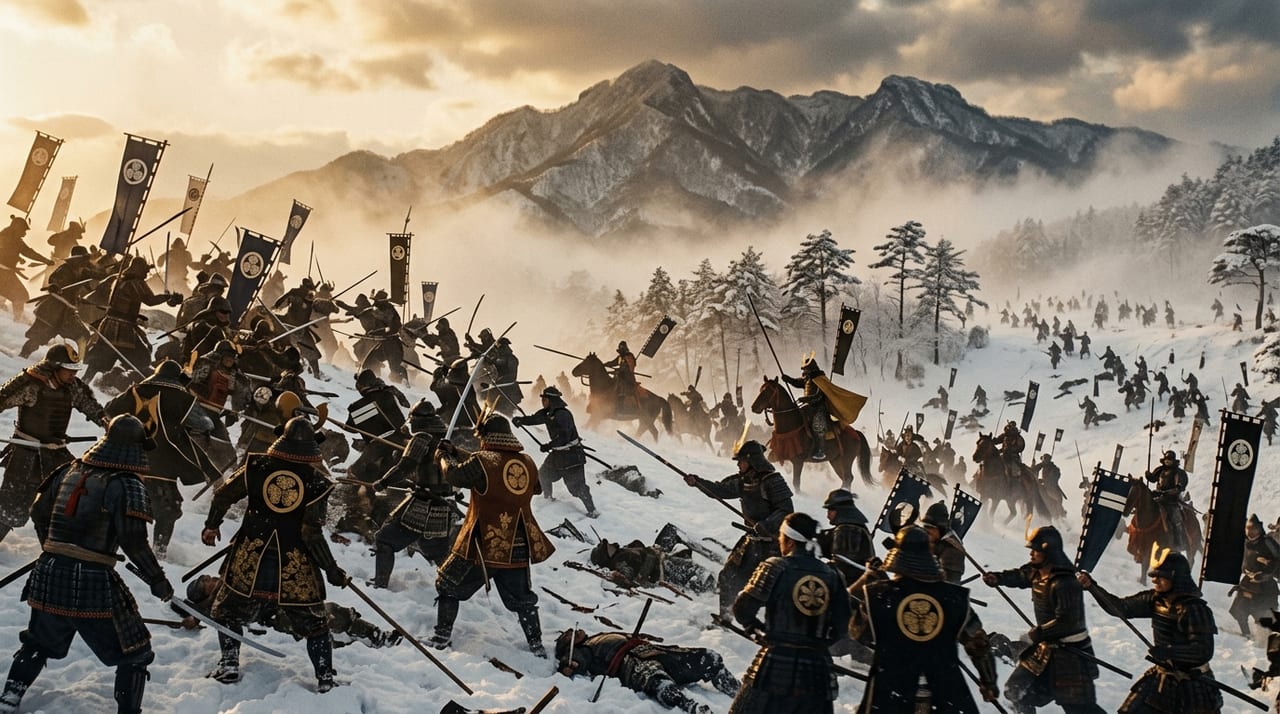
The rebel forces decided to entrench themselves at Hara Castle (Harajō) on the southern tip of the Shimabara Peninsula—a fortress that had once served as the seat of the Christian daimyo Arima Takakuni. Within its walls, approximately 37,000 peasants, ronin, and civilians held out against the shogunal army with minimal weapons and supplies.
The commanding officer of the shogunal forces was Matsudaira Nobutsuna, a senior councilor who deployed every military means at his disposal—from Sengoku-era siege tactics to the latest Western-style artillery—to encircle Hara Castle. The besieged, entrenched in the castle's stone walls, resisted with limited weaponry but eventually succumbed to starvation and disease as supplies dwindled.
After approximately 100 days of siege, the shogunal army launched a final assault, annihilating the defenders. All of the rebellion's leaders, including Amakusa Shirō, were killed, and approximately 37,000 lives were lost within the castle, according to contemporary accounts. The severed heads were subsequently counted and recorded in official records.
**The Event's Aftermath and the Deepening of Isolationism**
The suppression of the Shimabara-Amakusa Rebellion became emblematic of the Tokugawa shogunate's consolidation of power. The event demonstrated nationwide that the Edo shogunate possessed overwhelming military might to quell any large-scale rebellion. Simultaneously, the incident accelerated the shogunate's nationwide persecution of Christianity, initiating the age of "kakure-kirishitan" (hidden Christians).
Recognizing the rebellion as originating in Christian faith, the shogunate intensified its anti-Christian proscription policy. The logic that Christian faith could inspire rebellion became perceived as a severe threat by the shogunal leadership. Simultaneously, the possibility that Catholic powers like Portugal and Spain might support Japanese Christians sparked crisis awareness within the regime.
As a result, the shogunate undertook a major pivot in foreign policy. Restrictions on foreign trade that had been implemented progressively from around 1633 evolved, following the Shimabara-Amakusa Rebellion, into a more definitive and comprehensive "sakoku" (closed country) policy. Foreign trade was restricted to a single port at Nagasaki, Portuguese traders were expelled in 1639, and thereafter only limited commerce with the Dutch was permitted.
**Christian Persecution and Hidden Christian Culture**
After the rebellion, the shogunate launched intense persecution of Christians nationwide. Those confessing their faith faced execution, while those who concealed their beliefs established secret prayer halls and transmitted their faith orally to subsequent generations. Through this process, a unique "kakure-kirishitan" (hidden Christian) culture emerged, blending official Catholicism with folk and Buddhist elements.
Hidden Christians practiced a dual-faced piety: they prayed before Buddhist statues while actually addressing Christ; they conducted Buddhist funeral rites while reciting Christian prayers. This concealed form of worship persisted for over 250 years, continuing until the Christian proscription edict was lifted following the Meiji Restoration in the late nineteenth century.
**Historical Assessment**
The Shimabara-Amakusa Rebellion appears at first glance to be a simple peasant uprising against economic oppression. Yet it simultaneously testifies to the profound roots Christianity had taken in Japanese folk society. The fact that peasants rose in armed rebellion on grounds of religious conviction and resisted shogunal authority illuminates how severe religious and spiritual oppression was within early-modern Japanese social structures. Simultaneously, the event brought about the decisive establishment of shogunal power. At the transition from the Sengoku to early Edo period, the shogunate's mastery as a truly unified nation-state was proven through overwhelming military mobilization. The nearly three centuries of Edo peace ("taiheiyaku") that would follow were founded upon this indiscriminate violence and the subsequent more concealed systems of oppression that ensued.