New Arrivals — Browse our catalog for the latest authentic Japanese sword arrivals. Browse →
6th–7th month, Tenshō 13 (1585)
All of Shikoku (principal battlefields: Sanuki, Awa, and Iyo)
Forces
Hashiba (Toyotomi) Forces
Chosokabe Forces
About 9 min read
The Shikoku Campaign (Shikoku-zeme), fought from the 6th month to the 7th month of Tenshō 13 (1585), was a battle in which Hashiba Hideyoshi (Toyotomi Hideyoshi) forced Chōsokabe Motochika, who had unified Shikoku, to surrender, marking a major milestone in the pacification of western Japan. It was an important military action in Hideyoshi's effort to unify the realm, on a par with the Kishū Campaign (the conquest of Negoro-ji and the Saika-shū) in the same year, and it also served as a prelude to the Kyūshū Campaign (the submission of the Shimazu clan) in Tenshō 15 (1587).
Chōsokabe Motochika (1539–1599) began as a local lord in Tosa Province (present-day Kōchi Prefecture). In Tenshō 3 (1575), he defeated Ichijō Kanesada in the Battle of Watarigawa (Shimanto River) and unified Tosa. Thereafter he rapidly extended his control over all of Shikoku, and by the spring of Tenshō 13 (1585) he had subjugated most of Iyo, Sanuki, and Awa, nearly achieving the "unification of Shikoku."
Motochika was not only skilled in military strategy but also had a high level of cultural refinement, and he devoted great effort to developing Tosa's local industries and agriculture.
Motochika initially maintained a good relationship with Oda Nobunaga, and although Nobunaga sarcastically called him "a bat on an island without birds" (tori naki shima no kōmori), he tacitly permitted Motochika's conquest of Shikoku. However, when Nobunaga died in the Honnō-ji Incident in Tenshō 10 (1582), a dispute over succession broke out (the Battle of Yamazaki and the Kiyosu Conference). As Hashiba Hideyoshi moved to seize real power over the realm, how to deal with Motochika became an issue.
From Tenshō 11 (1583) onward, Hideyoshi began moving to resolve the Shikoku problem. Hideyoshi demanded that Motochika return Sanuki and Iyo, but Motochika sought a compromise by offering to return only Iyo Province, and the negotiations broke down. In the Battle of Komaki-Nagakute in Tenshō 12 (1584) (Hideyoshi vs. Tokugawa Ieyasu), Motochika briefly showed signs of coordinating with the Tokugawa and Oda Nobukatsu camp, but when that battle ended in a truce, Motochika's isolation deepened.
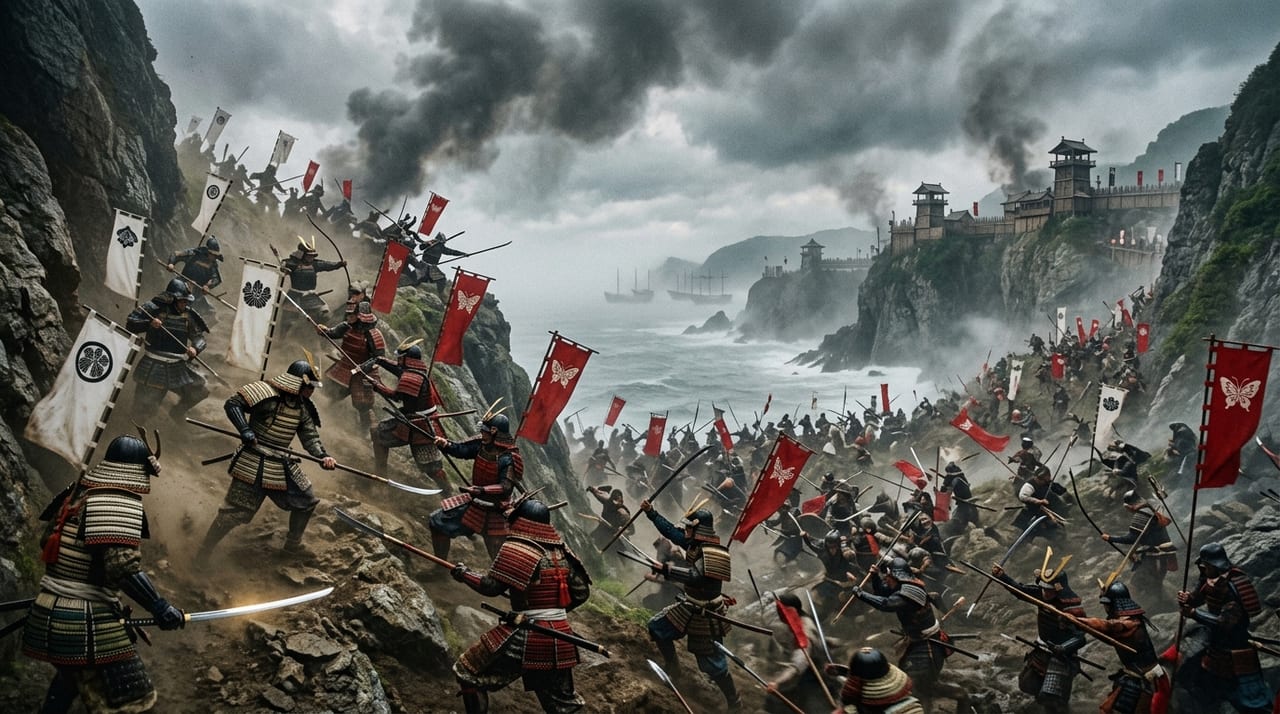
In the 6th month of Tenshō 13 (1585), Hideyoshi completed the organization of his expeditionary army to Shikoku. A three-pronged simultaneous invasion plan was adopted: the forces of Hashiba Hidenaga (Hideyoshi's younger brother) and Hashiba Hidetsugu, numbering about 60,000, advanced from Awaji to Awa; the forces of Ukita Hideie and others advanced from Bizen to Sanuki; and the Mōri forces led by Kobayakawa Takakage advanced from Aki into Iyo. Total forces are estimated at roughly 100,000.
Motochika tried to build a defensive line by stationing troops in castles throughout the region, but in the face of overwhelming disparity in forces, castles fell or surrendered one after another.
On the 25th day of the 7th month (lunar calendar), Chōsokabe Motochika resolved to surrender. Motochika accepted the peace on the condition that he be confirmed in possession of Tosa Province alone.
Although the Shikoku Campaign saw fighting such as the sieges of Kizu Castle and Ichinomiya Castle in Awa and the fall of Takao Castle in Iyo, no decisive battle took place in which the main forces of both sides clashed. Faced with a great army of 100,000, Chōsokabe-side castles opened their gates or fell one after another, and Motochika himself avoided a head-on decisive battle and accepted the truce.
However, the indirect impact of the Shikoku Campaign on sword history was significant. Because Motochika's surrender brought Shikoku within Hideyoshi's sphere of control, the Sword Hunt edict (katanagari) of Tenshō 16 (1588) came to apply to Shikoku as well.
Motochika, enfeoffed with Tosa Province alone, also took part as one of Hideyoshi's vassals in the invasions of Korea (the Bunroku and Keichō campaigns). Motochika's descendants sided with the Western Army (Ishida Mitsunari) at the Battle of Sekigahara (1600), and after their defeat the Chōsokabe family was subjected to kaieki (confiscation of the domain). Tosa was granted to Yamauchi Kazutoyo (the Tosa domain), and Yamauchi rule continued until the Bakumatsu period.
The Kōchi Prefectural Museum of History and Folklore, which stands on the ruins of Okō Castle (Nankoku, Kōchi Prefecture), the former home castle of the Chōsokabe family, has a Chōsokabe exhibition room where materials on the Chōsokabe family and the ruins of Okō Castle are displayed.