New Arrivals — Browse our catalog for the latest authentic Japanese sword arrivals. Browse →
527–528 (Keitai 21–22)
Mii District, Chikushi Province (around present-day Kurume, Fukuoka Prefecture)
Forces
Yamato court forces
Forces of Tsukushi no Kimi Iwai
About 9 min read
In 527 (Keitai 21), one of the largest regional rebellions in the history of the Yamato court erupted in northern Kyushu. Recorded in the Nihon Shoki as the "Rebellion of Iwai," this event was far more than a local chieftain's defiance—it forced a fundamental reckoning with Wa-state foreign policy, regional governance, and military organization in the first half of the 6th century.
The crisis began when Emperor Keitai sought to dispatch a massive force of 60,000 troops under the general Ōmi no Kena to the southern Korean peninsula, aiming to restore Wa influence over the Gaya (Imna) confederacy. Gaya was weakening under pressure from Silla at the time, and the Yamato court, keen to preserve its long-standing ties and interests there, planned a large-scale military intervention.
Standing in the way of this plan was Tsukushi no Kimi Iwai, a regional chieftain who had built formidable power across northern Kyushu, based in Chikushi Province (present-day Fukuoka Prefecture) but extending into Hi Province (Higo and Hizen, present-day Kumamoto, Saga, and Nagasaki) and Toyo Province (Buzen and Bungo, present-day eastern Fukuoka and Ōita). According to the Nihon Shoki, Iwai accepted bribes from Silla and was induced to obstruct Ōmi no Kena's army from passing through Kyushu en route to the peninsula. For Iwai, who had cultivated independent diplomatic relations with Silla and Baekje, unchecked Yamato intervention on the peninsula posed a direct threat to the regional hegemony he had built in Kyushu.
Iwai seized control of Hi and Toyo provinces and blockaded the maritime routes connecting Kyushu to the Korean peninsula, forcibly halting the advance of Ōmi no Kena's expeditionary force. This was not mere non-cooperation but an armed rebellion that directly challenged the foreign policy of the Yamato court itself.
Faced with this obstruction, Emperor Keitai appointed Mononobe no Arakahi, who held the rank of Ōmuraji, as general and ordered the subjugation of Iwai. The Mononobe clan, as a hereditary military house responsible for overseeing the court's armed forces, provided the era's leading military commanders, and Arakahi was among the foremost of his generation.
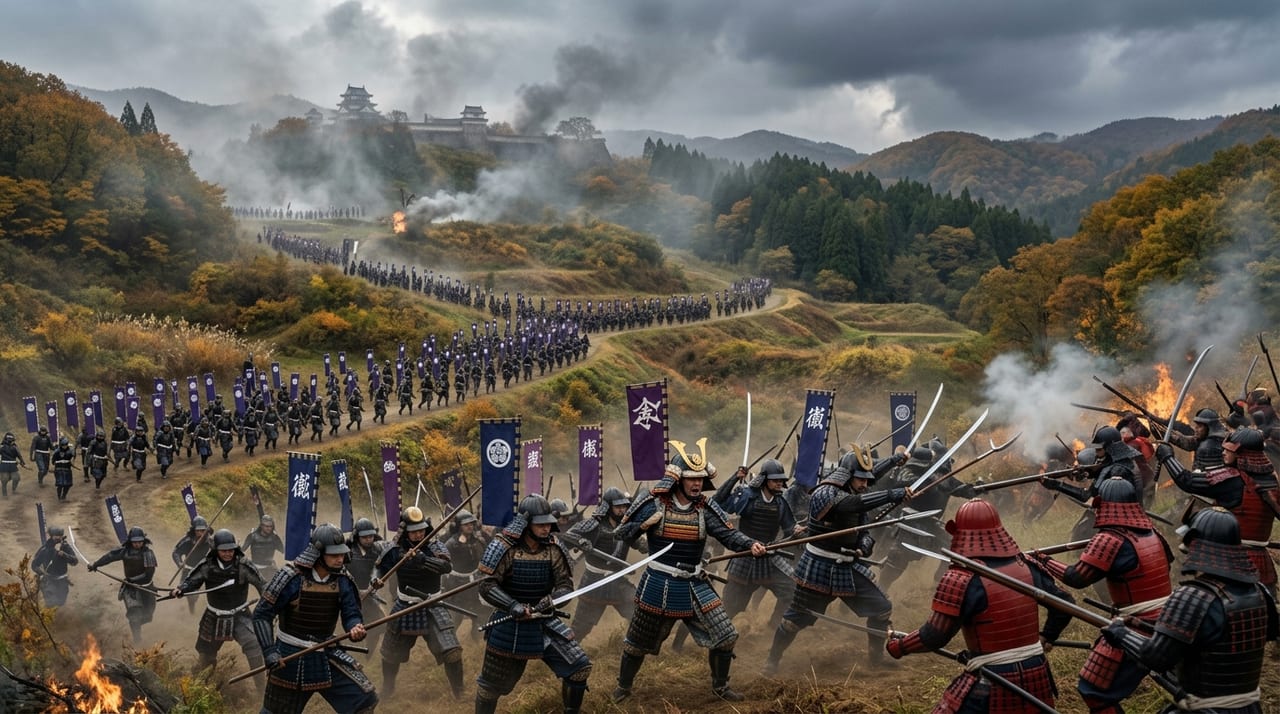
In November 528 (Keitai 22), the two armies clashed in Mii District of Chikushi Province (around present-day Kurume City, Fukuoka Prefecture). The Nihon Shoki describes the engagement in vivid terms—banners and drums facing each other, dust rising as the armies closed, the outcome of life and death hanging in the balance—conveying that both sides fought with everything they had. Iwai's forces, built up over years of dominance in northern Kyushu, were formidable, and suppressing them required considerable time and cost.
After the fierce fighting, Iwai is said to have been slain by Arakahi. However, a fragment of the Chikugo Fudoki preserves an alternative tradition in which Iwai fled to Kamitsumike District in Buzen Province, leaving his final fate a matter of dispute among the historical sources.
Following Iwai's defeat, his son Tsukushi no Kimi Kuzuko, seeking to avoid execution by implication, offered the Kasuya granary (in present-day Kasuya District, Fukuoka Prefecture) to the court. The miyake was a directly administered royal estate, and this offering meant that the strategic territories once controlled by the Iwai lineage in northern Kyushu were absorbed into the direct control of the Yamato court.
In the aftermath of the rebellion's suppression, the Yamato court accelerated the reorganization of regional governance in Kyushu, expanding the kuni no miyatsuko (provincial governor) system and the network of miyake estates, thereby strengthening efforts to incorporate regional chieftains into the court's emerging bureaucratic structure. The rebellion thus marks a pivotal turning point in the Yamato court's advance toward archipelago-wide centralized rule, and is regarded as one of the starting points of the regional administrative history that would culminate in the later ritsuryō state.
An important archaeological counterpart to the rebellion is the Iwatoyama Kofun in present-day Yame City, Fukuoka Prefecture, believed to be Iwai's tomb. This keyhole-shaped burial mound has yielded stone human and horse figures (sekijin and sekiba) unique to the region, testifying to the distinctive funerary culture and expressions of authority among late Kofun-period Kyushu chieftains. The military strength behind Iwai's rebellion is thought to have rested on northern Kyushu's iron resources and weapons production, cultivated through independent exchange with the continent and the Korean peninsula. Straight swords (chokutō) were the dominant blade type of this era, and the numerous iron artifacts excavated from Kyushu's kofun clusters remain vital archaeological evidence for understanding both the reception of continental ironworking culture and the parallel development of indigenous Wa smithing techniques. The Rebellion of Iwai thus stands as a crucial episode illuminating the realities of Wa foreign relations and regional power during the transition from the mythic age of the chronicles to the historical era of ancient Japan.