New Arrivals — Browse our catalog for the latest authentic Japanese sword arrivals. Browse →
15th day of 7th month, Bunroku 4 (August 20, 1595)
Kyoto; Mt. Kōya; Fushimi Castle; Sanjō Riverbank
Forces
Toyotomi Hideyoshi Side (Accuser)
Toyotomi Hidetsugu Side
About 17 min read
Toyotomi Hidetsugu (1568–1595) was born the son of Nisshū, the elder sister of Toyotomi Hideyoshi. Hideyoshi, who had no children of his own, adopted Hidetsugu. In Tenshō 19 (1591), Hideyoshi retired from the post of Kampaku and transferred that position to Hidetsugu at the same time. Hidetsugu became Kampaku, responsible for governing the realm, at just 23 years of age, and began his path toward becoming the ruler of the realm as Hideyoshi's successor.
Hidetsugu's rule was by no means a dark one. Although he would later be saddled with the infamy of being called the “Murderous Kampaku,” in actual governance he carried out relatively mild policies and also showed deep interest in scholarship and the arts. In Kyoto he cultivated the tea ceremony, waka, and renga, and actively engaged with cultured figures. He directed official ceremonies at Jurakudai, and while arranging relations with the emperor and the court nobles, he displayed the authority of Kampaku.
Hidetsugu also led troops. In Tenshō 12 (1584), at the Battle of Komaki and Nagakute, he went into battle as commander of a detached force and was decisively defeated by the Tokugawa side. He later distinguished himself in the Kii and Shikoku campaigns and in the Odawara campaign (the attack on Yamanaka Castle). He functioned as an indispensable member of Hideyoshi's project to unify the realm. Even after becoming Kampaku, he mediated disputes in various regions and handled administrative affairs from his position of command over the daimyō across the country, contributing to the stability of the Toyotomi regime.
Things changed suddenly in Bunroku 2 (1593). Yodo-dono, a concubine of Hideyoshi who had lost her young son Tsurumatsu, gave birth to a boy once again. This was the later Toyotomi Hideyori.
The birth of Hideyori, Hideyoshi's own child, fundamentally altered the structure of succession within the Toyotomi regime. For Hidetsugu, it meant that the basis of his position was lost. For Hideyoshi, it was the moment when a father's instinct to have his own blood child inherit the realm began to outweigh his political judgment.
At first, Hideyoshi continued to treat Hidetsugu outwardly as his successor. Arrangements were also advanced for one of Hidetsugu's daughters to become Hideyori's betrothed, and a system in which the two coexisted on the surface was maintained. However, as Hideyori grew, Hideyoshi's attention was clearly directed toward Hideyori. Daily friction arose between the two, and the contradiction of a dual power structure, Kampaku and Taikō, began to surface.
In the 7th month of Bunroku 4 (1595), a sudden accusation reached Hideyoshi that Hidetsugu had a “plot of rebellion.” There are various theories about who led the accusation. The view that it was slander by bugyō officials such as Ishida Mitsunari derives from later war chronicles. Today, the prevailing view holds that the bugyō merely carried out Hideyoshi's orders.
Whether Hidetsugu actually planned a rebellion remains unclear even now. No positive evidence has been found that Hidetsugu intended rebellion, and many historians point out the possibility that the accusation was politically engineered. Who stood to gain most from Hidetsugu's removal? It goes without saying that it was Hideyoshi himself, who wished to make Hideyori his successor.
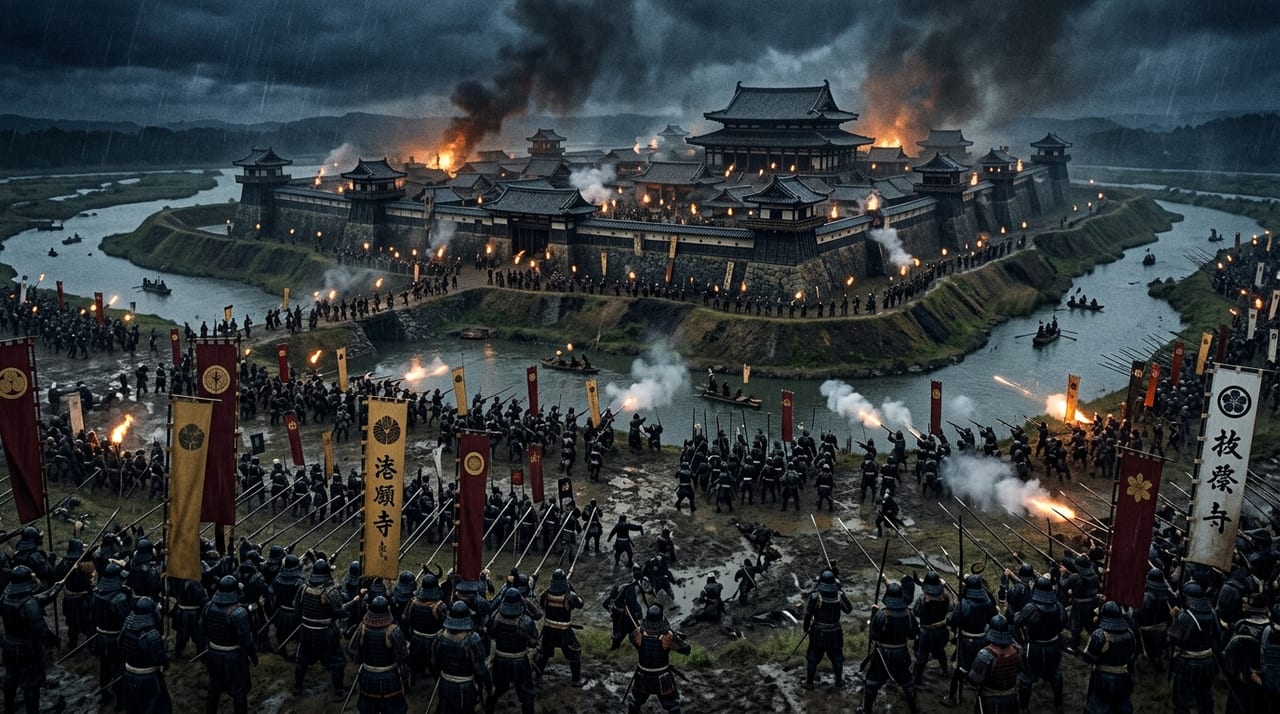
Having received the accusation, Hidetsugu was ordered to retire into confinement on Mount Kōya. On August 20, 1595 (Bunroku 4/7/15), he committed seppuku at Seigan-ji on Mount Kōya. He was 28 years old at his death. His retainer Sasabe Shigemasa served as kaishaku, and Hidetsugu's head was put on display at Sanjō riverbank.
The fact that the incident did not end with Hidetsugu's seppuku alone is what makes this event especially cruel.
On September 5, 1595 (Bunroku 4/8/2), Hidetsugu's wives, concubines, attendant women, and children, 39 people in all, were brought out to Sanjō riverbank in Kyoto and beheaded. Young children were not exempted either; all were executed.
So appalling was the scene that it is also said jeers aimed at the bugyō arose from among the onlookers. Sanjō riverbank was already known as a place of public execution and the display of severed heads, but the calamity of this incident came to be remembered as a tragedy particularly notable even in that history.
Toyotomi Hidetsugu is said to have owned many famous swords as Kampaku. The Azuchi-Momoyama period was the time when the culture of collecting and bestowing famous swords as “symbols of the ruler of the realm” reached its peak. After Hidetsugu's death, the famous swords he possessed were dispersed. As power changed hands, famous swords moved with it. This is a historical pattern that recurred throughout the Sengoku period.
The Hidetsugu Incident became a stepping stone toward the Battle of Sekigahara (1600). Within the Toyotomi regime, the rift between the bugyō faction led by Ishida Mitsunari and the military-faction (budan-ha) daimyō such as Fukushima Masanori and Katō Kiyomasa deepened all at once after Hideyoshi's death (1598). Mitsunari resigned his post as bugyō, withdrew to his domain, and eventually came to face Sekigahara as the figurehead of the Western Army.
Five years after Hidetsugu's death, the Battle of Sekigahara broke out. Beneath this battle, in which the internal contradictions of the Toyotomi house exploded, lay the chain of resentment and suspicion that the Hidetsugu Incident had produced. And after Sekigahara, under the Tokugawa age, the era of the sword shifted to a new phase: the refinement of sword culture in an age of peace.
The tragedy of Toyotomi Hidetsugu continues to pose questions today as a lesson of history. No matter how high one's position, there was an age when an individual life was brushed aside before the logic of power. And in that age, the sword was the final enforcer of that logic. Had Hidetsugu lived in a peaceful age, his literary talent and flexible political skill might have contributed to the long-term stability of the Toyotomi regime. History cannot speak of “what ifs,” but Hidetsugu's grave still remains at Zuisen-ji in Kyoto, and every year many people visit to pay their respects. The memorial tower enshrining Hidetsugu and his family quietly tells, across more than four centuries, the tragedy where power and the sword intersected. The memory of one military commander who loved swords and favored the arts, and who was tossed about by the logic of his age, is historical testimony that should be passed down to today through the Japanese sword.
Famous swords of the Azuchi-Momoyama period moved along with the fates of their owners. The group of famous swords said to have been possessed by Hidetsugu was dispersed after the incident. Within the Toyotomi regime, famous swords (meibutsu tōken) were not mere tools but were themselves symbols of the regime's legitimacy and power.
Each time a famous sword changed hands, it took on a new “story.” Among the swords that flowed out of Hidetsugu's storehouse after his death, there may have been some that later became gyobutsu of the Tokugawa shogunal house and were placed alongside legendary famous swords such as the “Tenka Goken.” In the world of Japanese swords, where a sword's provenance (raireki) is the basis of its value, the historical tragedy of the Hidetsugu Incident was sometimes engraved into that provenance as well.
The tragedy of Toyotomi Hidetsugu once again shows that famous swords functioned as symbols of power at a turning point in history, and that their possession carried political meaning. History told through swords is the essence of the cultural value of Japanese swords, and the Hidetsugu Incident should be remembered as an important page in that cultural history.
The Tenshō and Bunroku eras (1591–1595), during which Hidetsugu served as Kampaku, mark the dawn of the “shintō era” in the history of Japanese swords. Just before the Keichō shintō (from 1596 onward), many excellent swordsmiths were active mainly in Yamashiro, Settsu, and Yamato, and the Toyotomi regime functioned as their patron.
Of particular note is the position of swords within the “tea-ceremony politics” that Hideyoshi and Hidetsugu actively promoted. Just as famous tea utensils were used as gifts and bestowals at tea gatherings, famous swords also functioned as ceremonial gifts that confirmed the bonds between daimyō and between lord and retainer. That Hidetsugu had cultural interests and enjoyed the tea ceremony also suggests his role within this culture of sword gifting.
The sword used by Sasabe Shigemasa, a retainer, for Hidetsugu's kaishaku was a blade by Nanto-jū Kanabō Hyōe-no-jō Masatsugu. This sword was passed down to the descendants of the Sasabe family and has since been donated to the Osaka Castle Museum. From this perspective as well, the Hidetsugu Incident is remembered as a historical event that illuminates one aspect of the history of Japanese sword culture, and as a memory of profound significance even for sword enthusiasts.