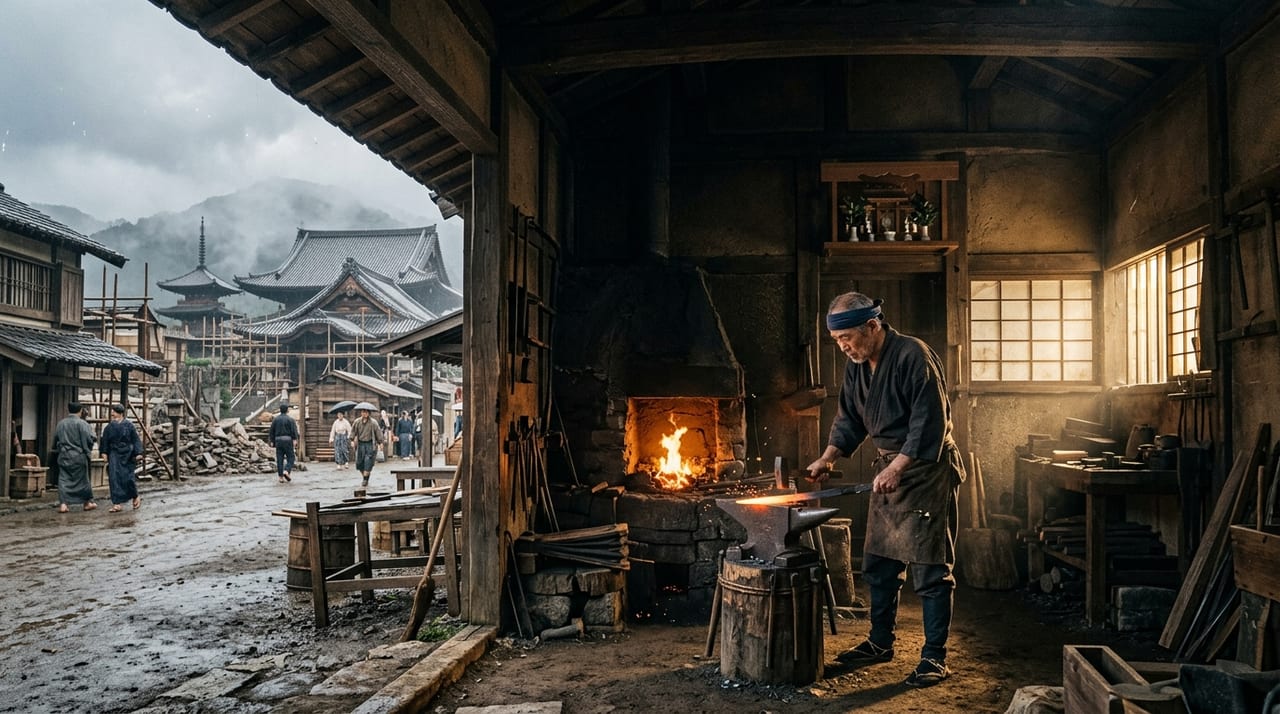
 * Image is for illustrative purposes only.
Tenna Era
天和(てんな)
Tenna (1681–1684) was a short era of the early Edo period, falling between Enpō and Jōkyō. In Tenna 1 (1681), Tatara Nagayuki — a student of Kawachi-no-Kami Yasunaga of Kii Province — relocated to Osaka and founded the Osaka Ishidō school. Nagayuki was ranked saijō ōwazamono, the highest grade, in the Edo-period cutting-test record Kaihō Kenjaku, and was noted for large dankō-midare hamon reminiscent of Bizen Ichimonji work.
Description
Placing the Tenna Era
Tenna (1681–1684) was a brief early-Edo era between Enpō and Jōkyō, under shogun Tokugawa Tsunayoshi and Emperor Reigen. Rarely discussed on its own in sword history, it marks the moment the Ishidō school, a major Osaka shintō lineage, took root in Osaka.
Nagayuki's Move to Osaka and the Ishidō School
Tatara Nagayuki, trained under Kawachi-no-Kami Yasunaga in Kii Province, relocated to Osaka in Tenna 1 (1681) and founded the Osaka branch of the Bizen-rooted Ishidō school, becoming its leading master. Osaka had, since Kanbun, produced smiths such as Inoue Shinkai and Tsuda Sukehiro, and Nagayuki's arrival enriched this concentration of talent.
Large Chōji-Midare Evoking Bizen Ichimonji
Nagayuki's bold dankō-midare hamon evoked the Kamakura-period Bizen Ichimonji school so closely that his archaizing pieces were often mistaken for genuine Ichimonji blades. He also produced late-Bizen-style work mixing gunome and chōji patterns.
Highest Rank in the Kaihō Kenjaku
The Edo-period cutting-test record Kaihō Kenjaku ranked Nagayuki saijō ōwazamono, the highest grade for both craftsmanship and cutting performance — achieved by only a limited number of smiths. The Ishidō lineage he founded in Osaka went on to shape later generations of Bizen-oriented Osaka shintō smiths.
Characteristics of This Era
- Tenna (1681–1684), though a short era between Enpō and Jōkyō, marks the founding of the Osaka Ishidō school
- Tatara Nagayuki, trained in Kii Province, moved to Osaka in Tenna 1 (1681) and founded the Osaka Ishidō school
- Nagayuki's work featured bold dankō-midare hamon evoking Bizen Ichimonji, at times mistaken for genuine old blades
- He also produced late-Bizen-style work mixing gunome and chōji patterns
- Ranked saijō ōwazamono, the highest grade, in the Edo-period cutting-test record Kaihō Kenjaku
- Represents Osaka shintō swordsmithing reaching a level combining practical cutting performance with aesthetic refinement