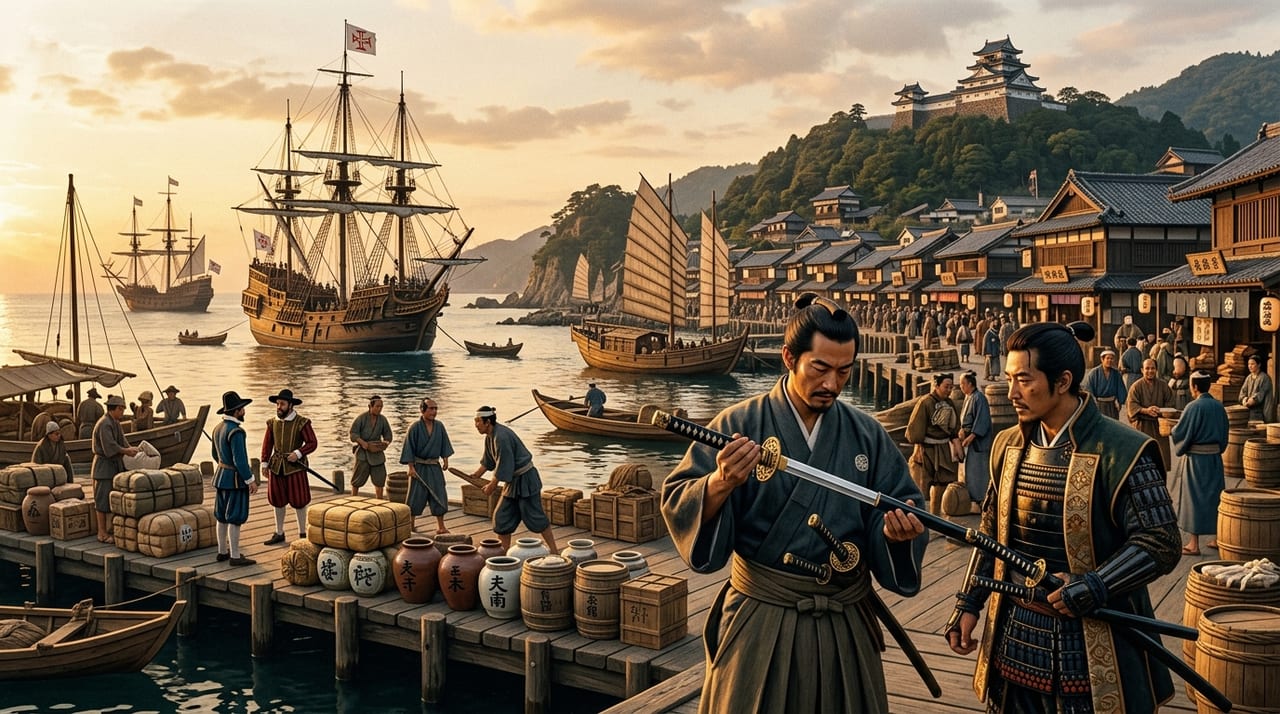
 * Image is for illustrative purposes only.
Nanban Trade and Sword Exports
南蛮貿易と刀剣輸出
From the arrival of the Portuguese at Tanegashima in 1543 (Tenbun 12) until the completion of the sakoku (closed country) policy in 1639, Japan actively traded with Europe and East Asia for about a century, and Japanese swords became one of its major export goods. While the introduction of firearms changed Japanese methods of combat, Japanese swords flowed out through the Nanban trade network to Southeast Asia, China, and Europe, widening overseas appreciation of Japanese swords.
Description
Introduction of Firearms to Tanegashima and the Transformation of Swords
In Tenbun 12 (1543), Portuguese men drifted ashore on Tanegashima and brought the matchlock firearm (teppō) to Japan. This event brought a revolution to Japanese modes of warfare and also caused a fundamental change in the role of swords. With the spread of firearms (during the Eiroku to Tenshō eras), mass volley fire on the battlefield became the main force, and combat shifted from being centered on mounted warriors to being centered on infantry-based gunners and spearmen. Within this change, demand for tachi declined. While demand for uchigatana and wakizashi shifted as auxiliary weapons for close combat, a tendency arose for swords, whose opportunities for actual use had relatively decreased, to concentrate cultural value as a "symbol of the samurai that transcended mere tools."
Nanban Trade and Sword Exports
Japanese swords also went overseas through the nanban trade (trade with Portugal and Spain). Swords were also among the major export items in the tally trade (kangō trade) with Ming China, and in China Japanese swords were called "wodao" (watō). In the Ming, Qi Jiguang adopted long-blade wodao for his army, and swords imitating Japanese swords were also produced. Export swords of this period were generally mass-produced (kazu-uchimono) in large numbers, but some high-quality tachi and swords also flowed out as trade goods.
Nanban Tsuba
Of the influences of the nanban trade, a notable one is the style of sword guard known as "nanban tsuba." It is a distinctive style in which foreign-style designs such as karakusa and crosses are rendered in iron, shakudō, and other metals; it was also made in the Edo period and is still appreciated today.
Christianity and Swords
As an issue inseparable from the nanban trade, there is the relationship between Christianity (Kirishitan culture) and swords. Jesuit missionaries, beginning with Francis Xavier, made efforts to build relationships with daimyō in their missionary activities in Japan. Ōmura Sumitada, Arima Harunobu, Takayama Ukon, and others are known as Kirishitan daimyō, and sword mountings (tōsōgu), such as tsuba bearing cross motifs, have been handed down.
Sakoku and the End of Sword Trade
In Genna 7 (1621), the shogunate forbade the English and the Dutch to carry weapons out of Japan, and with the sakoku edict of Kan'ei 16 (1639), which banned Portuguese ships from entering port, the nanban trade came to an end. Afterward, foreign trade was limited to trade with the Dutch trading post at Nagasaki and with Chinese ships. Some of the Japanese swords that went overseas are now held in museums and art galleries across Europe, bearing witness to the long history of international appreciation of Japanese swords.
Characteristics of This Era
- International commercialization of Japanese swords: they went overseas through the Nanban trade and trade with Ming China, and in China they were called wodao
- Nanban tsuba: a style of sword guard displaying foreign-style patterns such as karakusa (arabesque scrolls) and crosses. It is also favored by modern enthusiasts
- Introduction of firearms and the cultural sublimation of swords: while the spread of guns changed the demand for swords as practical weapons, their cultural value as the 'symbol of the samurai' was intensively reinforced. Swords accelerated their transformation into cultural properties
- Kirishitan daimyō and cross designs: sword fittings incorporating Christian motifs have been transmitted, such as tsuba bearing cross patterns
- Export of wodao to Ming and technical influence: Qi Jiguang adopted long-bladed wodao for the Ming army, and swords imitating Japanese swords were also made in China