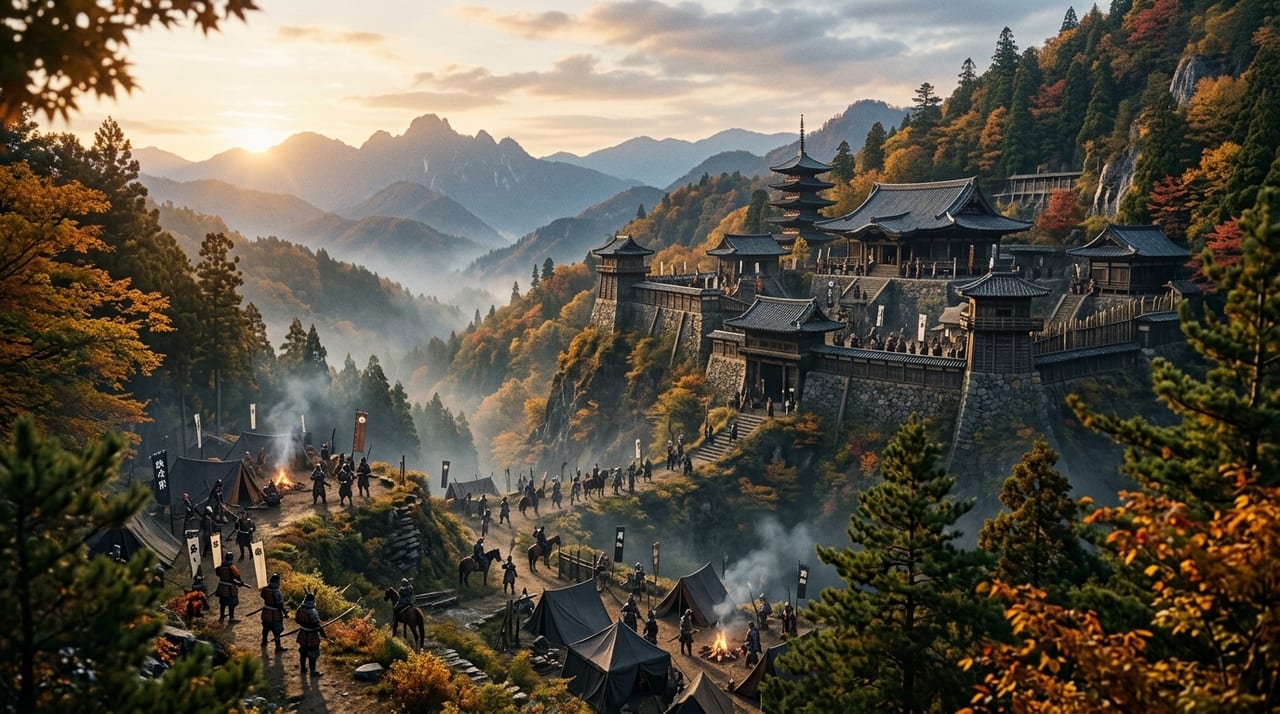
 * Image is for illustrative purposes only.
Era of the Shōchū and Genkō Incidents
正中・元弘の変期
The period of intensifying movement to topple the Kamakura bakufu under Emperor Go-Daigo. The turbulent decade from the Shōchū Incident (1324) and the Genkō Incident (1331) to the fall of the Kamakura bakufu (1333) formed the final phase of sword development, linking late Kamakura blades to the great tachi of the Nanbokuchō period.
Description
Anti-Bakufu Movement and Samurai Unrest
The Shōchū Incident (1324) was Emperor Go-Daigo's first attempt to topple the Kamakura bakufu, but it was discovered in advance and ended in failure. The emperor did not give up. In the 1st year of Genkō (1331) he again plotted to overthrow the bakufu (the Genkō Incident). After holding out at Mount Kasagi, he was captured and exiled to Oki Island. This series of upheavals gravely damaged the political authority of the bakufu and produced discontent with the bakufu among warriors in the western provinces, along with a leaning toward support for the emperor. Following the uprisings led by Kusunoki Masashige and others, Ashikaga Takauji and Nitta Yoshisada turned against the bakufu and joined Emperor Go-Daigo's side. In the 3rd year of Genkō (1333), the bakufu fell.
The Mature Form of Late Kamakura Blades
The swords of this era represent the final, complete form of the late Kamakura style, and at the same time they carry characteristics of the transition into the Nanbokuchō period. The style of late Kamakura, established after the Mongol invasions (1274 and 1281), featured imposing tachi that were broad in width, thick in kasane, and had extended kissaki. In the Shōchū to Genkō period this style developed further, with blade width increasing and kissaki growing longer. Osafune Kagemitsu and Kanemitsu of Bizen were active in this era, which could be called the eve of the Nanbokuchō period. They left behind imposing works that show the forerunners of the great tachi of the Nanbokuchō period known as Enbun-Jōji.
Osafune Kanemitsu and the Style of the Shōchū Period
Osafune Kanemitsu was a grandson of Nagamitsu. His works have a transitional beauty, in which large kissaki associated with the Nanbokuchō period begin to emerge on the imposing late Kamakura body lines. Represented especially by Kanemitsu, the master smith of Bizen Osafune, the Bizen blades of the late Kamakura to Nanbokuchō period held an overwhelming position. In the Shōchū to Genkō period, which preceded the Nanbokuchō upheaval, sword production received demand not only from the bakufu as official smiths but also from western warriors who joined the movement to topple the bakufu and from warriors on the southern court side. Production centers in Bizen, Yamashiro, and Yamato were active.
Exile to Oki and a Break in Culture
The short period from the 2nd year of Genkō (1332), when Emperor Go-Daigo was exiled to Oki, to the Kenmu Restoration (1334) was a time when court culture and warrior culture clashed violently. Kyoto smiths were placed in a complicated position, receiving commissions from both the court side and the bakufu side. Kunimitsu of Yamashiro (Rai Kunimitsu), a smith active in this era, left behind outstanding works that show a transitional style spanning the late Kamakura period to the early Nanbokuchō period. He is a valuable witness who conveys the reality of smiths who survived a turbulent age. A sword said to have been worn by Kusunoki Masashige was handed down as a legend and was revered as a symbol of the southern court side.
"Akutō" and the Spread of Weapons
One of the defining features of this era is the rise of the "akutō," armed peasants and emerging warrior groups. Kusunoki Masashige himself was originally a local landholder known as an akutō of Kawachi. The participation in combat of these lower-ranking warriors and armed commoners broadened the base of sword demand, creating demand not only for high-grade famous swords but also for practical, mass-produced blades. Bizen smiths developed production systems for both high-quality and practical swords, which shows one aspect of the process by which Japanese sword production spread throughout society.
Effects of the Fall of the Bakufu
With the fall of the Kamakura bakufu in the 3rd year of Genkō (1333), smiths of Sagami (present-day Kanagawa Prefecture), who had been active under the bakufu, lost their patron. Meanwhile, the style of Masamune influenced smiths across the provinces. Through smiths of Etchū, Mino, and Chikuzen, who are said to be students in Masamune's line, the Sōshū-den style spread to various regions.
Characteristics of This Era
- Coexistence of the mature late Kamakura style and the budding of Nanbokuchō characteristics. Imposing forms, broad in width and thick in kasane, with kissaki gradually extending, mark this transitional period
- The peak of Bizen Osafune with Kagemitsu and Kanemitsu. Distinctive hamon flourished, including kataochi-gunome (Kagemitsu) and ō-gunome-midare (Kanemitsu)
- Spread of the Sōshū-den. Through smiths across the provinces recognized as Masamune Juttetsu, the Sōshū-den style spread nationwide
- The rise of akutō warriors such as Kusunoki Masashige expanded demand for practical blades. A polarization developed between high-grade famous swords and mass-produced practical swords
- The political turmoil of the movement to topple the bakufu and the Kenmu Restoration directly affected smith activity. Changes in patrons shifted the rise and fall of each production center