 * Image is for illustrative purposes only.
The Osafune Workshop System and Formation of Sword Production Centers
長船の工房制度と刀剣産地の形成
Osafune in Bizen Province (modern Setouchi City, Okayama) became Japan's largest sword production center during the late Kamakura and Nanbokuchō periods, achieving this dominance through an organized workshop system and producing master smiths including Mitsutada, Nagamitsu, Kagemitsu, and Kanemitsu.
Description
Geographical Advantages of Osafune
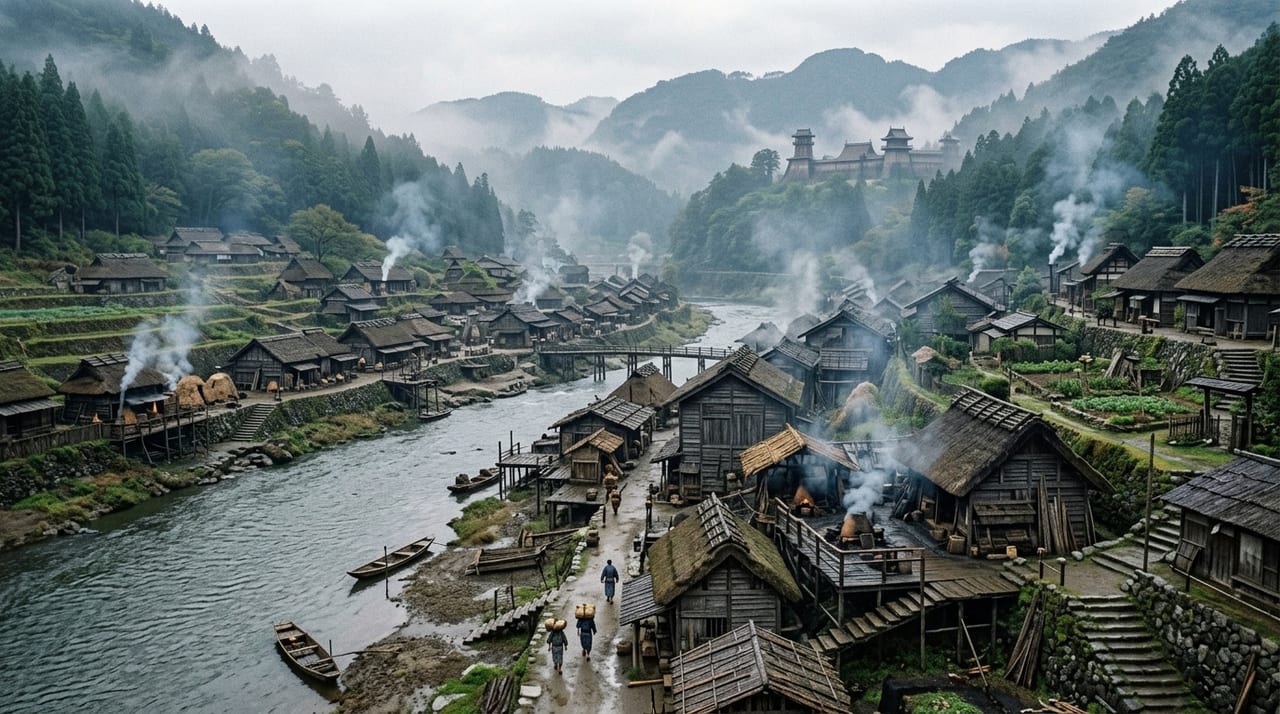
Bizen Osafune is located in present-day Osafune-chō, Setouchi City, Okayama Prefecture. Drawing on iron sand and charcoal from the Yoshii River basin, and possessing a mild climate and water transport that made it convenient to move raw materials and products, this area had ideal conditions for sword production from the Kamakura period onward. In particular, the Yoshii River functioned as a main artery of river traffic and also served as a logistical foundation for distributing finished swords to various parts of the country.
The Osafune Lineage in the Late Kamakura Period
Osafune's development began in the latter half of the 13th century. The Osafune lineage, founded by Mitsutada of the mid-Kamakura period, established Osafune as the center of sword production in Bizen Province during the generations of Mitsutada's son Nagamitsu and grandson Kagemitsu.
Nagamitsu (active in the late Kamakura period, from the latter half of the 13th century to the early 14th century) has many extant works and is regarded as a representative smith of the Kamakura-period Bizen-den. It is especially characterized by a dense nioi-deki hamon and a uniformly refined jigane, and numerous tachi combining practicality and beauty were produced.
Kagemitsu (late Kamakura period) is said to have been a son of Nagamitsu, and dated works from Kagen 4 (1306) to Kenmu 1 (1334) survive. The kataochi-gunome hamon, said to have been originated by Kagemitsu, is well known, and the jigane with well-packed ko-itame is considered the most beautiful within the Osafune school.
Workshop System and Mass Production
A notable feature of the Osafune lineage lies in its organized workshop system. While there are outstanding works bearing the names of Nagamitsu, Kagemitsu, Kanemitsu and others, it is thought that a division of labor existed in which disciples took on part of the sword-making. As a result, it became possible to meet large volumes of orders under the signature of an accomplished master.
Social unrest and the increase in warfare during the Nanboku-chō period rapidly raised demand for swords. To meet this demand, Osafune developed a more organized production system and also played a central role in the mass production of "Nanboku-chō ōdachi." The fact that numerous ōdachi exceeding 3 shaku in length were made in Osafune during the Nanboku-chō period shows the scale of orders and production at the time.
Kanemitsu and the Completion of Nanboku-chō Osafune
A leading Osafune smith of the Nanboku-chō period is Kanemitsu (a son of Kagemitsu, active in the mid-14th century). Kanemitsu left numerous swords reflecting the vogue for long blades, shallow curvature, and ō-kissaki of the Nanboku-chō period. From around the Enbun era, works were made with a notare hamon mixed with gunome, incorporating the influence of the Sōshū-den into the Bizen-den.
Characteristics of This Era
- Dense and orderly Bizen-den hamon based on nioi-deki
- Balance of high quality and mass production through an organized workshop system
- Formation of a production center utilizing the iron sand and charcoal resources of the Yoshii River and water transport
- Technical innovation represented by Kagemitsu's kataochi-gunome
- Production of ōdachi in the Nanboku-chō period