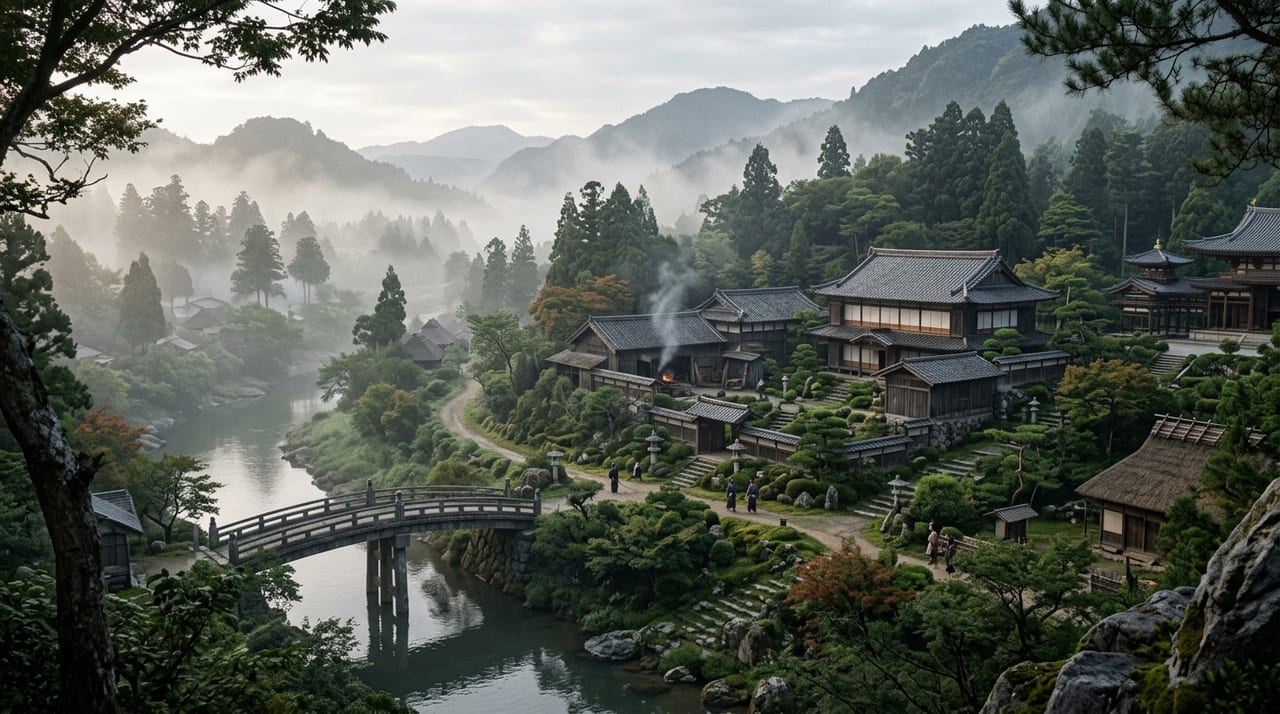
 * Image is for illustrative purposes only.
The Ōei Stability Period and Regional Smiths of Southern Yamashiro
応永の安定期と南山城の地方刀工
During the mid-Ōei period, as shogunal power stabilized, demand for swords across the nation increased, and smiths in southern Yamashiro developed their own distinctive styles.
Description
From Ōei 20 to 35 (1413–1428), Japan under Muromachi shogunate control enjoyed a period of relative domestic stability under the fourth shogun, Ashikaga Yoshimochi. The Ōei Disturbance (1399) caused by Ōuchi Yoshihiro had subsided, and while there was military friction with the Korean peninsula known as the Ōei Invasions (1419), the domestic political order maintained a certain equilibrium. Ashikaga Yoshimochi shifted from his predecessor Yoshimitsu's active diplomatic approach toward inward-looking policies, including temporarily halting the Japan-Ming Kanpō trade. This political reorientation was also reflected in the cultural sphere, marking the beginning of a transition from the lavish culture of the Yoshimitsu era—which engaged both court and military societies—to a more restrained martial aesthetic. From the perspective of sword manufacture, this stable period represented a transition away from the Southern and Northern Courts era, when bulk demand for crude ōdachi had driven production, returning instead to more refined and aesthetically conscious sword-making.
The southern region of Yamashiro Province (present-day Kyoto Prefecture), particularly southern Yamashiro (present-day areas around Jōyō, Yawata, and Uji), cultivated its own distinctive regional smith culture during this period. While positioned at a suitable distance from Kyoto's political and cultural center yet within its sphere of influence, southern Yamashiro produced smiths who, working from the traditional techniques of the Yamashiro lineage, achieved distinctive stylistic developments. This region, through which the Uji and Kizu rivers flowed, had been a source of high-quality iron sand and charcoal since antiquity, providing natural conditions favorable for sword-making operations.
Among Yamashiro smiths of the Ōei era, particularly noteworthy is the body of work bearing the signature 'Ōei Nobukuni.' Nobukuni was a lineage of Yamashiro smiths active since the Southern and Northern Courts period, and many works bearing the 'Nobukuni' signature were produced during the Ōei era. The technical characteristics of Ōei Nobukuni are evident in the regular progression of gunome-chōji blade patterns—a combination of gunome and chōji—and the beauty of jikei visible in the bright, lustrous jigane. In contrast to the rough large irregular waves of the Southern and Northern Courts period, Ōei Nobukuni blades are characterized by orderly, disciplined beauty and contributed significantly to the formation of Muromachi-period sword aesthetics. Extant works by Ōei Nobukuni are held in public and private collections throughout Japan, including the Tokyo National Museum, forming an essential body of material for empirical research on early Muromachi swords.
Sanjō Yoshinori and the group of smiths identified as different bearers of the name Yoshinori derive from the Sanjō lineage, named after the Yamashiro location, and were active from the Ōei through Eikyō periods. Works by Sanjō Yoshinori preserve the fine ko-itame jigane of the Yamashiro lineage while demonstrating distinctive developments with characteristic variations in the hamon. While surviving works by Sanjō Yoshinori bearing a signature are few, their technical level holds a position referenced as the 'paradigm of early Yamashiro Muromachi swords' in subsequent Muromachi sword research. It is also suggested that multiple generations of Yoshinori smiths from the same lineage may have been active, making this a significant consideration in research on Yamashiro smith lineages from the Ōei through Bunʻan periods.
A common technical characteristic of southern Yamashiro smith works from the Ōei through Eikyō periods is a tendency toward usuzukuri (thin construction). During the transition from the robust ōdachi of the Southern and Northern Courts period to practical uchigatana and tachi of the Muromachi era, southern Yamashiro smiths emphasized refined sword-making that prioritized blade thinness and sharpness. In the jigane, they retained the itame-textured grain of the older Yamashiro lineage tradition while displaying individual characteristics through the fine distribution of jinie. The kissaki showed a transitional tendency to reduce from the large kissaki of the Southern and Northern Courts to the medium kissaki, while the sori of the tachi also became shallower as the era progressed.
The historical significance of this period in sword history lies in the technical refinement marking the transition from the era of disturbance to the period of stability. The shift from the Southern and Northern Courts era's 'mass production and battlefield use' to the Ōei–Eikyō period's 'refinement and aesthetics' formed the foundation of subsequent Muromachi sword culture, and particularly served as a bridge to the later flourishing of the Bizen lineage (Eikyō through Bunʻan periods). Southern Yamashiro regional smiths, bridging Kyoto's central smith culture with local distinctiveness, constituted a period that played an indispensable role in the formation of Muromachi sword history.
Characteristics of This Era
- Ōei Nobukuni gunome-chōji hamon — The regular progression of orderly gunome-chōji blade patterns, as a departure from the large irregular waves of the Southern and Northern Courts era, embodied the sword aesthetics of the Ōei stable period
- Southern Yamashiro regional smith culture — Southern Yamashiro, maintaining suitable distance from Kyoto's center, formed a regional sword culture sphere that nurtured distinctive developments based on the Yamashiro lineage tradition
- Tendency toward usuzukuri — As technical refinement during the transition from the ōdachi era to the uchigatana period, an inclination toward precise sword-making emphasizing blade thinness and sharpness
- Transitional formation of Muromachi-period sword aesthetics — The shift in production style accompanying the transition from the era of disturbance to the stable period prepared the aesthetic foundation for later Muromachi swords
- Sanjō Yoshinori-lineage local smiths — Early Muromachi regional smiths based in Yamashiro Sanjō played a role bridging inheritance of the Yamashiro lineage tradition with local distinctiveness