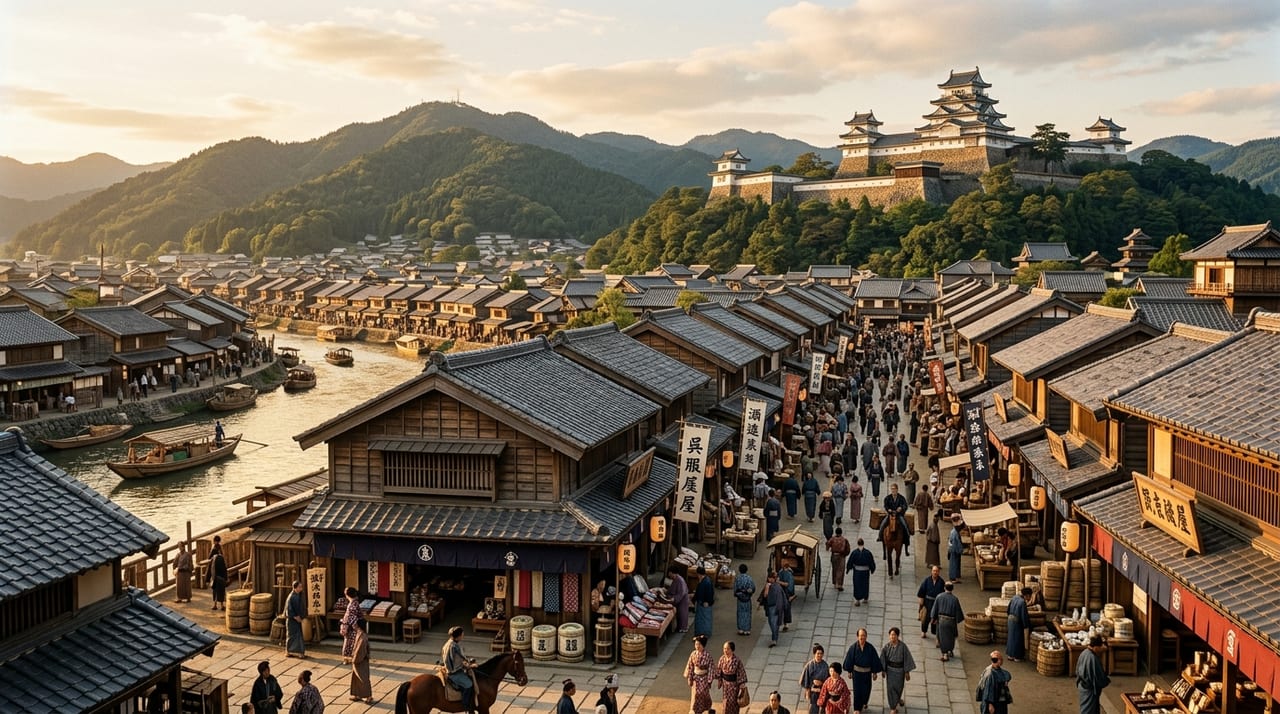
 * Image is for illustrative purposes only.
Commoners, Merchants, and Swords—Edo-Period Military Arts Culture
町人・商人と刀——江戸の武具文化
Swords were not the exclusive domain of the samurai. Edo's thriving urban culture generated new traditions of sword collecting, appraisal, and sword furniture arts. This essay explores an era when wealthy commoners, merchants, and literati savored the beauty of Japanese blades, nurturing distinctive sword culture through certificates of authentication, oshigata (blade rubbings), and sword rankings.
Description
Peace and the Culturalization of Japanese Swords in Edo
During the more than 260 years of relative peace in the Edo period (1603–1868), the role of the Japanese sword transformed dramatically from a practical weapon of warfare to a cultural and spiritual symbol. While samurai retained the obligation and pride of wearing the blade as 'the soul of the warrior,' opportunities to actually use swords in combat became extremely rare. Paradoxically, this era of 'unused swords' stimulated the refinement of the aesthetic and craft value of Japanese blades, fostering the maturation of a distinctive culture of sword appreciation. One of the most noteworthy phenomena in Edo-period sword culture was that blades ceased to be the exclusive domain of the samurai class. Wealthy commoners, merchants, literati, and scholars came to recognize the artistic value of Japanese swords and devoted themselves passionately to collecting and appreciating fine blades. In the prosperous urban centers of Osaka, Kyoto, and Edo, professional sword merchants (blade dealers and sword traders) became established, and specialized professions in the buying and selling, appraisal, and restoration of fine blades were formalized. Many of the fundamental mechanisms of the modern sword market—certificates of authentication, folded certificates, and provenance records—were established during the Edo period.
The Honami Family and the Establishment of Appraisal Culture
At the center of Edo-period sword appraisal culture stood the Honami family. The Honami family had engaged in sword polishing, cleaning, and appraisal as their hereditary profession since the Muromachi period and was officially recognized by the Tokugawa shogunate as an authority on sword appraisal. Honami Kōetsu (1558–1637) was a cultural figure of the early Edo period who was active in many fields, including calligraphy, ceramics, and lacquer inlay (maki-e). The appraisal certificates issued by the Honami family, called orikami (folded papers), functioned as official documents certifying the value of blades. The term orikami derives from the practice of folding a sheet of washi (traditional Japanese paper), such as hōsho-gami, in half horizontally. These certificates recorded the smith's name and a daizuke (a valuation stated as a number of gold pieces, in the form dai kinsu … mai). Orikami became indispensable documentation for the sale of fine blades. Swords bearing an orikami became known as 'orikami-tsuki' (with an orikami), and this expression became established in the Japanese language as a term signifying something of guaranteed worth—exemplifying how profoundly Edo sword culture influenced Japanese linguistic culture. Beyond the Honami family, other families and individuals also engaged in sword appraisal. The Kyōhō Meibutsu-chō (Register of Notable Blades of the Kyōhō Era, 1716–1736), a compilation made by the Honami family at the command of Tokugawa Yoshimune that recorded celebrated swords passed down in the shogunal house, the daimyo households, and others, became an important reference work establishing standards for later sword collecting and appraisal.
The Culture of Oshigata—Documenting the Japanese Sword
Oshigata (blade rubbings) are records of swords created by placing washi paper against the blade and hand-drawing tracings of the outline, hamon (temper line), the skin of the steel (jihada), and the signature. With the advent of the Edo period, the technique of oshigata advanced significantly, and the creation of precise rubbings became an integral part of the cultivation of serious sword enthusiasts. Particularly celebrated are the oshigata and sword drawings by Honami Kōtoku, such as the Honami Kōtoku Katana Ezu (Honami Kōtoku's Sword Drawings), which remain indispensable as primary documents for modern sword appraisal and research, serving as invaluable records of classical (koto) blades. Oshigata was an excellent documentation technique that recorded detailed information about blade form and hamon without damaging the blade itself, and it served the important role of preserving knowledge of celebrated swords that no longer survive. The fact that Edo literati competed to produce superior oshigata collections testifies that Japanese swords were socially recognized not merely as weapons but as works of art and cultural treasures. In contemporary sword scholarship, Edo-period oshigata are still utilized as primary sources, providing fundamental reference data for the authentication of classical blades.
Sword Furniture Arts—From Military Equipment to Fine Art
In Edo-period sword culture, the art of tōsougu (sword fittings) commanded attention equal to or greater than the blades themselves. Tōsougu refers to the ornamental metal fittings that comprise a sword's exterior: the tsuba (hand guard), menuki (grip ornaments), kozuka (small utility knife hilt), kōgai (hair pin), and fuchi/kashira (hilt collar and pommel)—these metal fittings were collectively regarded as independent works of art. During the Edo period, each domain retained hereditary metal-workers specializing in sword fittings. Families such as Gotō, Ishiguro, and masters like Yokoya Sōmin produced fittings of the highest caliber. The precise carving and inlay work (zōgan) executed in gold, silver, and copper alloys (such as shibuichi, akagane, and pure copper) represent the pinnacle of Edo metalcraft, rivaling the refinement of contemporary European watches and jewelry. Wealthy merchants and literati developed the custom of commissioning sword fittings combining blades by renowned smiths with fittings by celebrated metal-workers, fostering a mature culture of appreciating the sword as a comprehensive work of art.
Sword Rankings and the Democratization of Sword Culture
Tōken banzuke (sword rankings) modeled after sumo wrestling rankings were also produced. These were lists assigning celebrated swordsmiths to sumo ranks—from ōzeki down to sekiwake, komusubi, and maegashira, east and west—functioning as entertaining, accessible media through which commoners could learn about and rank swordsmiths. Sword rankings were produced as single-sheet prints, suggesting that interest in swords had spread beyond the samurai class. The contemporary popularity of swords—interest in video games such as Tōken Ranbu and public enthusiasm for sword exhibitions—can be understood as a modern extension of this Edo-period sword culture for the masses.
The Collector's Legacy and Its Transmission to the Modern Era
The greatest legacy bequeathed by Edo-period sword collecting culture was the systematization of appraisal, documentation, and evaluation. The contemporary Society for Preservation of Japanese Art Swords' (NBTHK) systems for designating swords as 'Special Important Swords' and 'Important Swords' are modernizations of the Honami orikami system of the Edo period. Moreover, portions of the sword collections assembled by wealthy Edo commoners and merchants were donated to museums, art galleries, and research institutions after the Meiji Restoration, forming the foundation of Japan's cultural heritage protection. The transformation of the Japanese sword from a samurai's practical tool to a cultural legacy was driven not by the warrior class alone, but by Edo's prosperous civil society as a whole. Reconsidering Edo-period sword culture from this perspective offers an essential framework for understanding the Japanese blade not merely as a weapon, but as an achievement of human culture.
Characteristics of This Era
- The Honami *orikami* system—official appraisal certificates recording the smith and the *daizuke* (appraised value). It was the direct precursor of the modern NBTHK appraisal certificate system and gave rise to the Japanese idiom *orikami-tsuki*
- The development of *oshigata* culture—the technique and practice of meticulously documenting blade form, hamon, and signature without damaging the steel. Edo-period *oshigata* collections serve as primary sources for modern classical blade research.
- The pinnacle of sword furniture arts—the metalwork created by families such as Gotō, Ishiguro, and masters like Yokoya Sōmin represents the apex of Edo craftsmanship. Sword fittings received artistic recognition equal to or surpassing that of the blades themselves, functioning as comprehensive works of art.
- *Tōken banzuke*—a single-sheet ranking of swordsmiths modeled on sumo *banzuke*. It suggests that interest in swords had spread beyond the samurai