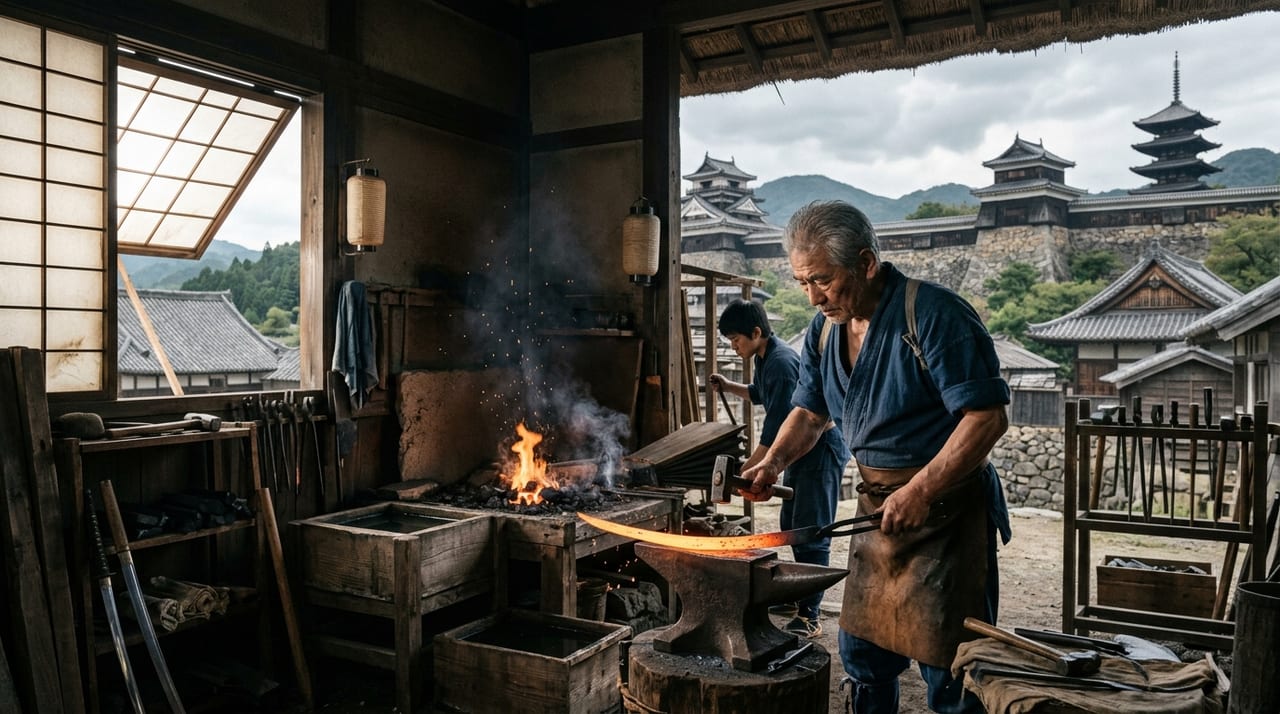
 * Image is for illustrative purposes only.
Kenjutsu Schools and Sword Evolution
剣術流派と日本刀の発展
Examines how major Japanese swordsmanship schools such as Ittō-ryū, Shinkage-ryū, and Jigen-ryū influenced the shape, length, and kasane (blade thickness) of Japanese swords. A history of the relationship between swordsmanship and swords, including the spread of shinai practice and the appearance of Kanbun shintō.
Description
The shape of Japanese swords was not determined solely by the smith's aesthetic sense and the properties of the material. Changes in the practice of swordsmanship (the precursor of kendō) also influenced the appearance of the blade. However, although there were cases in which martial artists had smiths forge swords specially ordered to suit their school, these were very few.
In the late Muromachi to Sengoku periods, the systematization of swordsmanship advanced rapidly. Early schools such as Nen-ryū, Kage-ryū, and Tomita-ryū took shape and became the sources of the later major schools. Swords of this era, reflecting the realities of Sengoku combat, were often designed purely for practical use.
Ittō-ryū, whose systematization was completed in the early Edo period (Itō Itōsai → Ono Tadaaki), held as its core the concept of "kiri-otoshi" (cutting down). It flourished when Ono Tadaaki became swordsmanship instructor to the Tokugawa shogunal house. Meanwhile, Jigen-ryū (Satsuma) was known for its unique "tonbo no kamae" (dragonfly stance) and a technique that staked everything on a single first strike. In the Satsuma domain, the distinctive long-hilted "Satsuma-goshirae" were widely used.
Shinkage-ryū (the Yagyū family), by serving as martial arts instructors to the Tokugawa shogunal house in Edo, exerted a major influence on swordsmanship in Edo. From around the Kanbun era, as swordsmanship came to center on shinai practice, swords close to the shinai, with shallow curvature and compact kissaki, were demanded. The rugged appearance of these "Kanbun shintō" was favored by martial artists.
In the late Edo period, many schools, including Hokushin Ittō-ryū (Chiba Shūsaku) and Kyōshin Meichi-ryū, conducted practical training in their dōjō. As shinai and bokutō training spread, demand for the design of real swords also diversified. Hokushin Ittō-ryū, in which Sakamoto Ryōma trained at the Chiba dōjō, is known for placing importance on practical and mobile technique. Then, with the decline of swordsmanship following the Haitō-rei (the 1876 edict banning the wearing of swords), the era of wearing swords came to an end.
Characteristics of This Era
- Changes in swordsmanship and the form of swords — the spread of shinai practice produced the shallow-curved Kanbun shintō form
- Jigen-ryū and Satsuma-goshirae — a swordsmanship staking everything on the first strike, and the distinctive long-hilted fittings
- Yagyū Shinkage-ryū — exerting a major influence on Edo swordsmanship as the Tokugawa shogunal house's official school