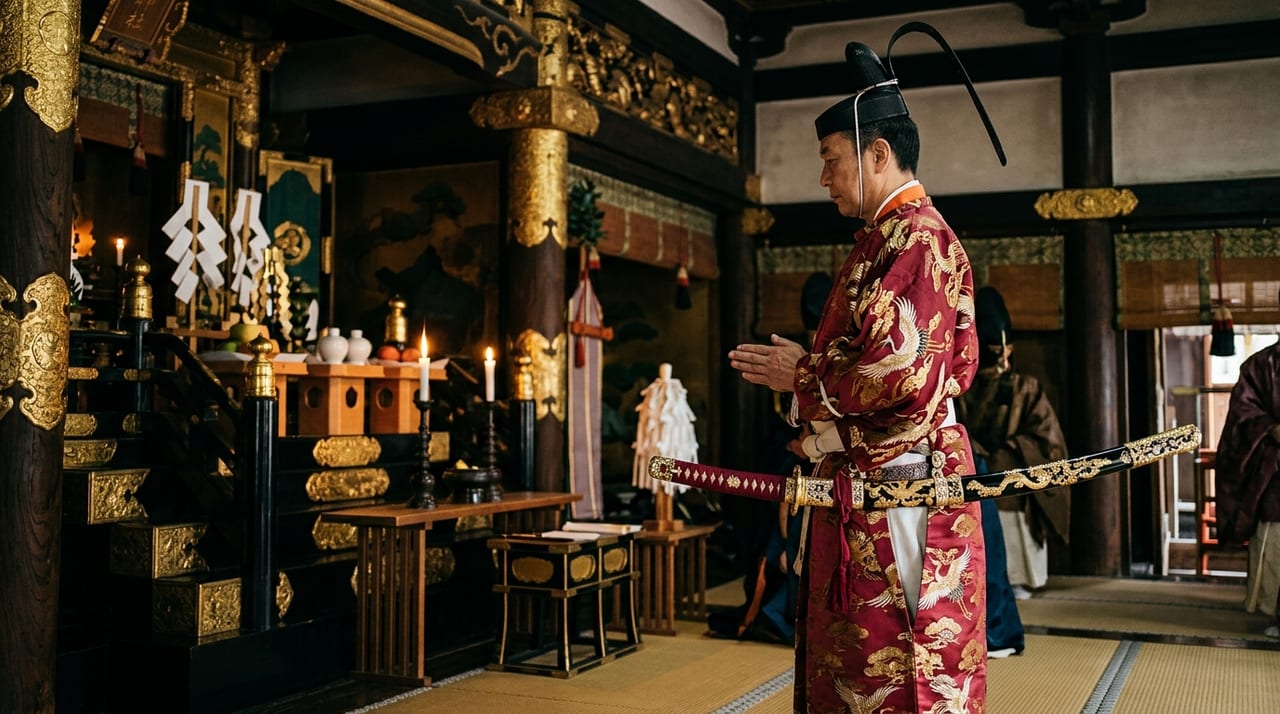
 * Image is for illustrative purposes only.
Kazari-tachi and Ceremonial Costume
飾太刀と儀礼装束
A cultural history of the kazari-tachi in the imperial court and kuge society. It examines the formal beauty of the tachi incorporated into court dress from the Heian period onward, its relationship to swords offered before the deities of shrines, and the shift to the hoso-dachi, which dispensed with decorative mountings.
Description
"Kazari-tachi" refers to an ornamental tachi made not for actual combat but to be worn at court and imperial ceremonies and processions. From around the Heian period, it came to be used in place of the earlier kara-tachi. Kazari-tachi are produced according to an aesthetic logic completely different from that of practical swords. Rather than the sharpness of the blade, the splendor of the koshirae, the elaborate combination of gold, silver, urushi lacquer, raden mother-of-pearl inlay, and kumihimo braided cords, was given the highest priority, and it functioned as a social sign that made the wearer's status and rank visible.
In the Heian court, the kazari-tachi was worn together with sokutai, the highest-ranking formal dress. Those permitted to wear a kazari-tachi were officials of nagon and sangi rank or above (senior counselors), and wearing one was proof of high noble status. For the hoso-dachi, which later spread as a substitute, regulations were set according to rank: the scabbard was to be kin-nashiji or kin-ikakeji for those of third rank and above, and gin-nashiji or gin-ikakeji for those of fourth rank and below. This shows that the kazari-tachi was not a mere accessory but a visible representation of the status order within the court.
Production of kazari-tachi was made possible by the collaboration of several specialist crafts: swordsmiths (blade), metalworkers (metal fittings), lacquer artisans (lacquering of the scabbard and hilt), and kumihimo braiders (sageo). In particular, the metalworking techniques used for kazari-tachi of the Heian to Kamakura periods were elaborate. They were based on continental techniques of the Nara period but grew further Japanized, and extant kazari-tachi are among the most important sources for the history of Japanese metalwork and lacquerwork. Representative surviving examples include the Kinji Raden Kenukigata Tachi (National Treasure) held by Kasuga Taisha, and the Ikakeji Raden Kinsō Kazari-tachi held by the Tokyo National Museum.
Dedication of kazari-tachi to shrines was an important route by which court culture spread to shrines and temples in the provinces. At major shrines such as Kasuga Taisha, dedicated swords were transmitted as sacred treasures (shinpō), and the Kinji Raden Kenukigata Tachi was among the objects removed from the main sanctuary during the periodic reconstruction (shikinen zōtai) in 1930 (Shōwa 5). When dedicated by warrior houses, kazari-tachi carried the religious meaning of prayers for long-lasting martial fortune, for victory in battle, and for thanks after victory.
Once the middle Heian period had passed, many people could no longer afford kazari-tachi for financial reasons, and ceremonial swords were gradually replaced by hoso-dachi, which omitted the decorative metal fittings. Kazari-tachi came to be worn only rarely. From the Edo period onward, there are many examples of swords forged by famous swordsmiths being mounted as hoso-dachi. With the Meiji period, the distinction between the two was abolished and they were unified as Girei no Tachi. Many kazari-tachi once owned by the former kazoku peerage are now held in collections of national museums and the like.
Characteristics of This Era
- Function as a marker of high rank: wearing was restricted to nagon and sangi (senior counselors) and above; the later hoso-dachi had regulations on gold or silver scabbard fittings by court rank.
- An aesthetic logic that prized the splendor of the mountings over the blade: an elaborate, integrated craft combining gold, silver, mother-of-pearl inlay (raden), lacquer and braided cord.
- Unity with court ceremony and sokutai court dress: the kazari-tachi functioned as a component of the costume system.
- Shrine dedication and spiritual authority: offered tachi as a religious act expressing prayers for martial fortune, victory and gratitude.
- Transition to the hoso-dachi: from the mid-Heian period onward, the hoso-dachi without decorative fittings became the principal ceremonial tachi, and in the Meiji period it was merged into the Girei no Tachi.