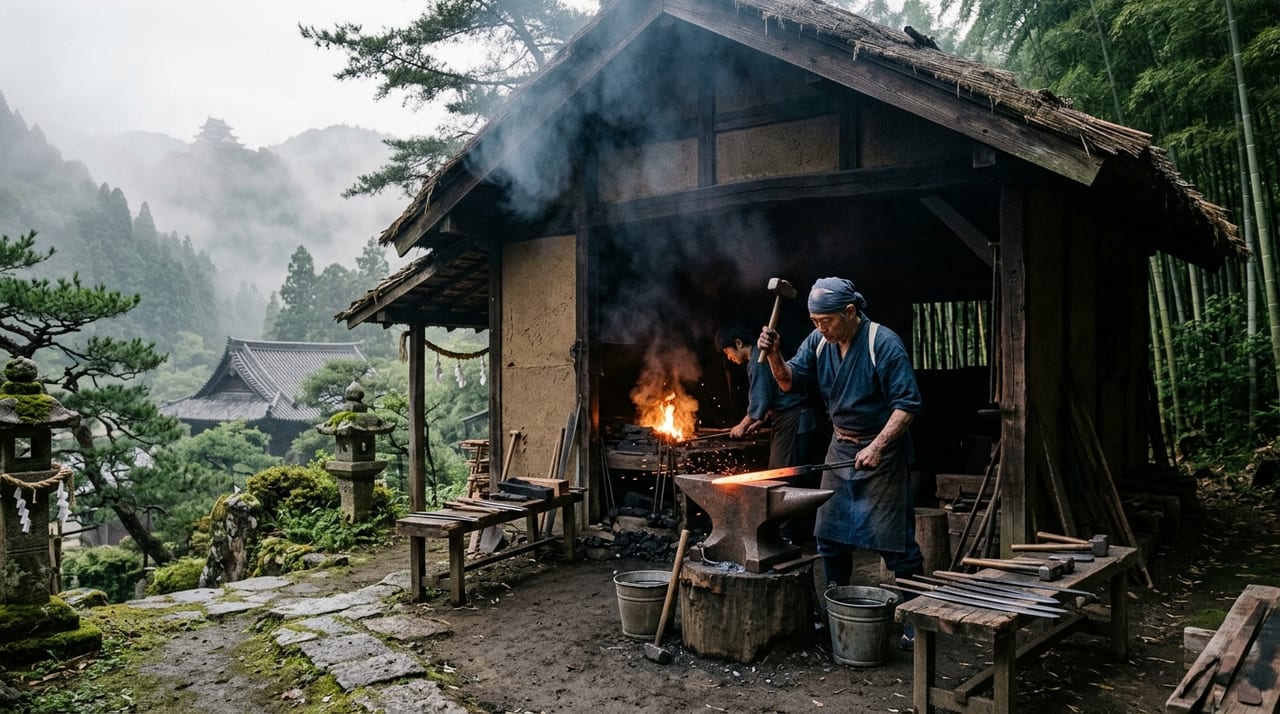
 * Image is for illustrative purposes only.
Gō Yoshihiro — The Supreme Master of the Soshu Tradition
郷義弘——相州伝最高峰の刀工
Gō Yoshihiro was a swordsmith active during the Nanboku-chō period in Matsukura-gō, Etchū Province (present-day Uozu City, Toyama Prefecture). Counted among the "Ten Great Disciples of Masamune," he was a renowned master of the Soshu tradition. Standing alongside Masamune and Awataguchi Yoshimitsu as one of the "Three Greatest Smiths Under Heaven," he is said to have died at the young age of twenty-seven. Almost no confirmed signed works survive; only unsigned pieces authenticated as the work of "Gō" by the Honami family and others have been transmitted to the present day. This rarity gave rise to an ancient saying: "One has never seen Gō or a ghost."
Description
Overview of Gō Yoshihiro
Gō Yoshihiro (his name Gō is also written 江) was a swordsmith who flourished during the Nanbokucho period in Matsukura-gō, Niikawa District, Etchū Province (present-day Uozu City, Toyama Prefecture). He is counted among the renowned masters as one of the "Ten Disciples of Masamune," exemplars of the Soshu tradition. Though ranked alongside Masamune and Awataguchi Yoshimitsu as one of the "Three Greatest Swordsmiths," he is said to have died young at only twenty-seven years of age. The name "Gō" (郷) derives from his residence in Matsukura-gō, while the alternate spelling "Gō" (江) is said to derive from his Ōe (大江) surname.
A Master without Signed Works—"Neither Gō nor Ghosts Have Ever Been Seen"
The defining characteristic of Gō Yoshihiro is the near-complete absence of extant works bearing his authentic signature. Whether due to his early death or other reasons, no works signed by his own hand have survived; all existing pieces are unsigned, and it is only through the attributions of later master appraisers such as Hon'ami Kōetsu that they have been authenticated as works of "Gō." From this circumstance arose the saying long transmitted through the sword world: "Neither Gō nor ghosts have ever been seen." Nevertheless, Gō Yoshihiro's works that bear reliable authentication receive evaluations comparable to or equal to Masamune's highest standards.
Artistic Style and Representative Works
The artistic style of Gō Yoshihiro is characterized by the beauty of nie within the Soshu tradition as its foundation, combined with bright and crisp ji-tetsu, and a brilliant hamon in which gunome is interspersed within notare, with gold threads and suna-nagashi appearing abundantly. It is highly valued as a body of work that combines the grandeur of his master Masamune with an elegance reminiscent of Kyoto-school blades. His representative works include the National Treasures "Inaba Gō" and "Tomita Gō," and the Important Cultural Property "Matsui Gō," all of which have been transmitted as supreme blades treasured by daimyo houses.
Evaluation and Legacy
The unique position of Gō Yoshihiro—counted among the Three Greatest Swordsmiths and the Ten Disciples of Masamune despite the absence of signed works—symbolizes that the evaluation of Japanese swords rests not on the presence or absence of a signature, but on the inherent beauty of the ji-tetsu and hamon themselves. As a swordsmith who, though working in Etchu Province, demonstrated one of the highest achievements of the Soshu tradition, Gō Yoshihiro's works remain to this day objects of admiration for sword enthusiasts and scholars alike.
Characteristics of This Era
- Its greatest feature is a dynamic hamon built on abundant nie. Its varied expression, with notare mixed with gunome, became the ideal form for the later Sōshū-den.
- The jihada combines masame and itame, with fine chikei and jinie flowing throughout, a complex expression. The deep forging of the jigane is unrivaled by others.
- Many works are recorded in meibutsuchō, led by the Kyōhō Meibutsuchō, and powerful figures including the Tokugawa shogunal family competed to obtain them.