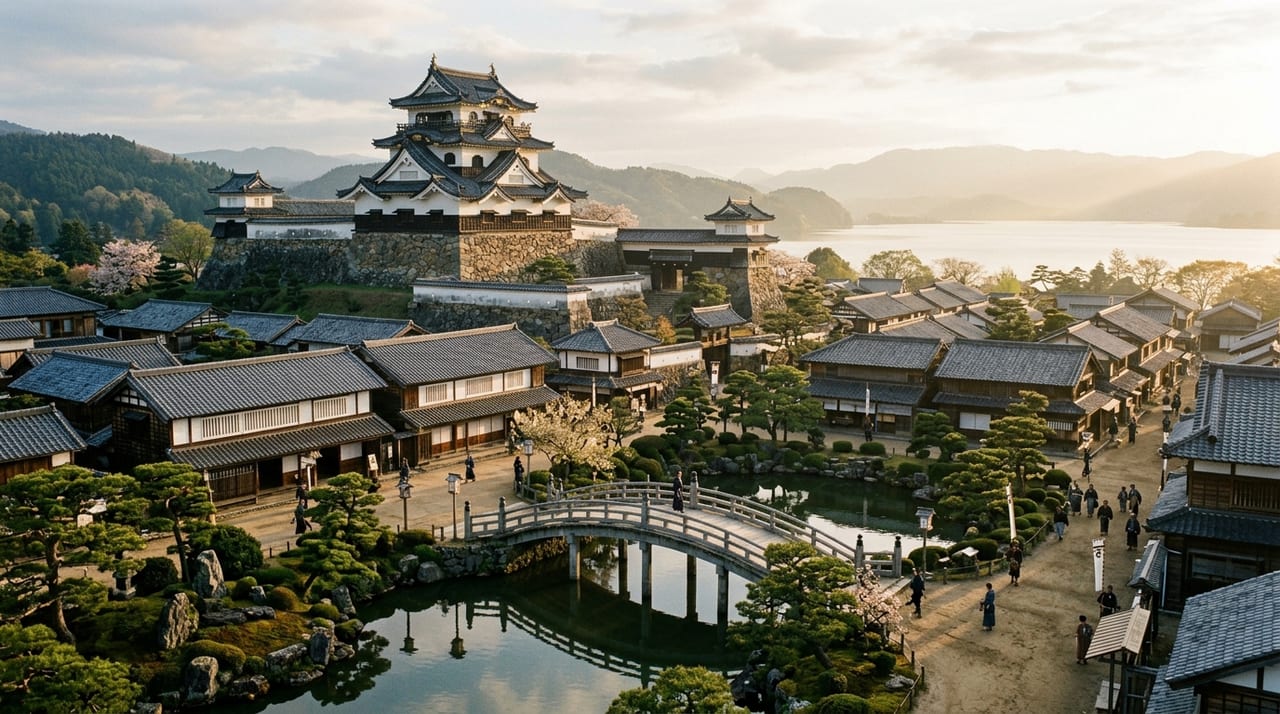
 * Image is for illustrative purposes only.
Genroku-Kyōhō Peace Era
元禄享保の太平期
The long peace from Genroku through Kyōhō transformed the sword from a weapon into an art object and status symbol. Sword fittings—tsuba, menuki, kozuka, kogai—flourished as independent art forms, with the Gotō, Shōami, Yokoya, and Yanagawa schools competing in decorative brilliance.
Description
Genroku Peace and the Transformation of the Samurai
The Genroku era (1688–1704) was a time of unprecedented peace and economic prosperity under the fifth shogun, Tokugawa Tsunayoshi. The concentration of samurai in Edo through the sankin-kōtai system and the growth of castle-town economies fundamentally changed the samurai way of life. The shift from the Sengoku-period view of the sword as a practical weapon for protecting one's life to the aesthetic view of the sword as a ceremonial object and work of art was decisively completed in this era. In particular, Tsunayoshi's civil-governance policy fostered an atmosphere that restrained martial matters and encouraged learning, and speaking of a sword's beauty and provenance became part of samurai culture.
The Golden Age of Sword Fittings
While the production of blades stagnated in both quantity and quality, the making of sword fittings reached unprecedented brilliance in the Genroku period. Metalwork pieces such as tsuba, menuki, kozuka and kōgai developed as independent works of art, and many metalworking schools competed, led by the Gotō family. As metalworkers serving the shogunal house, the Gotō family held a hereditary monopoly position, and their high-relief carving of delicate traditional court and warrior-custom motifs, known as iebori, shows the highest standard of the time. Yokoya Sōmin departed from the closed style of the Gotō family and established an innovative metalwork that expressed bold compositions and realistic flowers, plants and animals using colored-metal techniques in gold, silver, copper and shakudō. Sōmin's works were called machibori in contrast to the Gotō family's iebori. They had a profound influence on later generations and were widely accepted in late Edo metalwork.
Blade Trends
The form of the Kanbun shintō blades, with shallow curvature and small kissaki, began to change around the Enpō period. Blades acquired a curve toward the tip and an extended kissaki, becoming gentle in form. Swords of this period are also called Genroku shintō. However, sword researchers often evaluate the Genroku period as a time when the level of blade making was not necessarily high. After Genroku, new demand for swords declined, and the number of smiths dropped greatly. When the Kyōhō era (1716–1736) began, under the Kyōhō Reforms of the eighth shogun, Tokugawa Yoshimune, frugality and thrift were encouraged, and a trend emerged that valued the quality of the blade over ornate koshirae.
The Development of Connoisseurship
The Genroku through Kyōhō period was also a time when the culture of sword appraisal and collecting developed greatly. The Hon'ami family, serving as appraisers for the shogunal house, issued origami, that is, appraisal certificates, and expressed the value of swords in monetary terms. During the Genroku era, outstanding appraisers such as Hon'ami Kōchū and Kōjō were active, and many origami were issued. Daimyō, hatamoto and wealthy merchants of Edo competed to collect famous swords. During the Kyōhō era, Hon'ami Kōchū compiled a ledger of famous swords, the Kyōhō Meibutsu-chō, at the command of Yoshimune. The prototype of sword collecting culture was formed in this period.
The Akō Incident and Swords
The blade assault by Asano Takumi-no-kami in the 14th year of Genroku (1701), and the following year's raid on Kira's residence by the Akō rōnin, spread throughout the country as a story of gishi (loyal retainers) that linked samurai honor with the sword. The swords used by the Forty-Seven Rōnin, including Ōishi Kuranosuke, were revered as gishi no katana, and they have been dedicated to and handed down at places such as the Akō Ōishi Shrine. This incident made all of society re-recognize that the sword was a symbol of the samurai spirit that went beyond a mere metal product, and it strengthened the spiritual foundation of sword culture.
Characteristics of This Era
- Genroku shintō form: shifted from the Kanbun shintō form, with shallow curvature and small kissaki, to a gentle form with a curve toward the tip and an extended kissaki
- Independent artistic status of sword fittings: tsuba, menuki, kozuka and kōgai were established as art objects bought, sold and collected separately from the blade. This was the era in which Yokoya Sōmin's innovation broke the traditional Gotō family style
- Maturation of the Hon'ami origami culture: Genroku-period origami expressed the value of swords in monetary terms
- Reaffirmation of the link between bushidō and the sword through the Akō incident: the gishi-tō of the Forty-Seven Rōnin were revered as spiritual symbols, and the sacred and righteous symbolism of the sword took root in popular culture
- Return to practicality under the Kyōhō Reforms: Yoshimune's frugality policy shifted demand from ornate koshirae to the quality of the blade, promoting the plain but solid style of the late shintō period