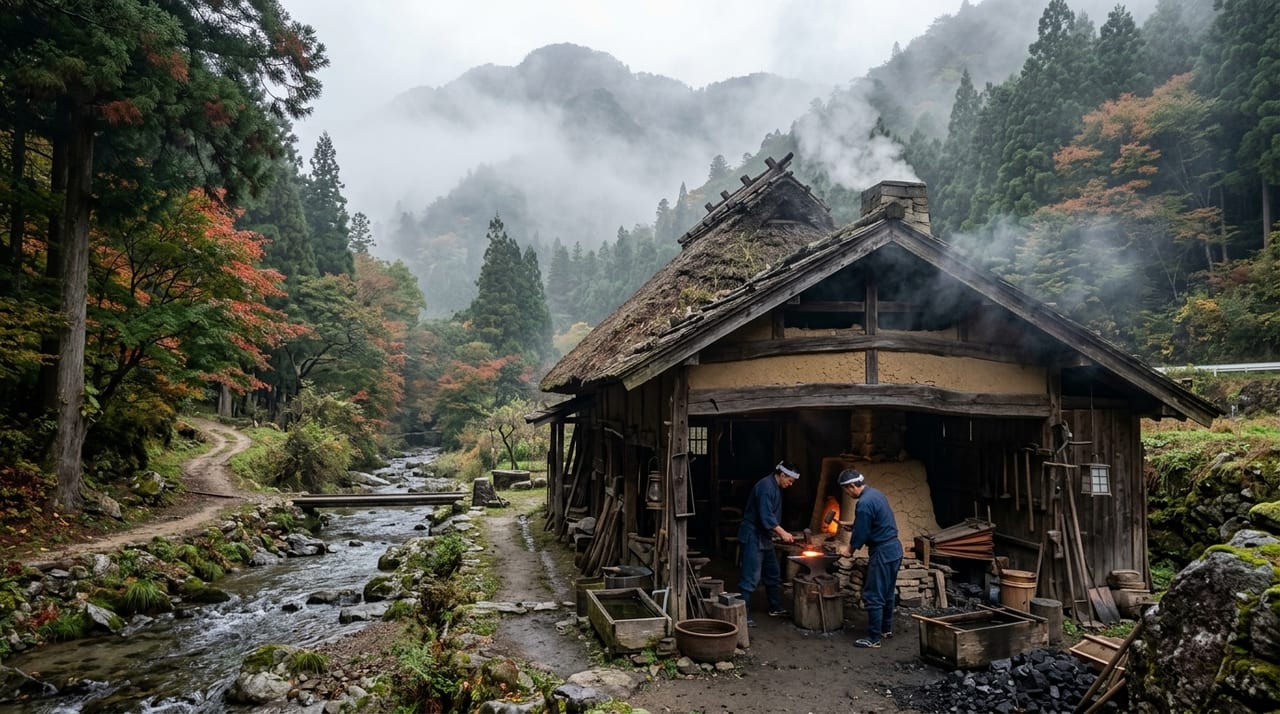
 * Image is for illustrative purposes only.
Gendaitō (Modern Art Swords)
現代美術刀剣
Having overcome the crisis of survival posed by the sword confiscation by GHQ, the Japanese sword has entered a new golden age as a purely artistic object. With Living National Treasures at its summit, contemporary smiths continue to pursue both tradition and creation, using tamahagane and ancient forging methods. This is the age of a “living tradition,” in which thousand-year-old techniques are indeed passed on to the next generation.
Description
The Crisis at the End of the War
The end of the war on August 15, 1945 (the 20th year of Shōwa) was the second crisis of survival for the Japanese sword. Under its policy of disarmament, the General Headquarters of the Supreme Commander for the Allied Powers (GHQ) carried out a large-scale sword confiscation across Japan. At first, GHQ regarded all Japanese swords as weapons and planned to confiscate and destroy them entirely. However, through the persistent negotiations of Japanese stakeholders, above all Honma Junji and other sword scholars and enthusiasts, it was decided that swords of artistic and historical value would be protected as art objects. The success of these negotiations was decisive for the survival of today's Japanese sword culture, and the achievements of Honma Junji deserve to be remembered forever.
Preservation Efforts
In 1950 (Shōwa 25), the Law for the Protection of Cultural Properties took effect. In 1954 (Shōwa 29), an amendment to that law established a system for certifying holders of Important Intangible Cultural Properties, commonly known as Living National Treasures. As a result, the traditional techniques of sword smiths gained a legal foundation for protection at the national level. The first Living National Treasure in the field of swords was Takahashi Sadatsugu (certified in 1955, Shōwa 30). Thereafter, Miyairi Yukihira (certified in 1963, Shōwa 38), the second Gassan Sadaichi (certified in 1971, Shōwa 46), Sumitani Masamine (certified in 1981, Shōwa 56), Amata Akitsugu (certified in 1997, Heisei 9), and Ōsumi Toshihira (certified in 1997, Heisei 9) were certified as Living National Treasures.
Intangible Cultural Properties
In 1948 (Shōwa 23), the Nihon Bijutsu Tōken Hozon Kyōkai (Japan Sword Preservation Society of Fine Arts), abbreviated NBTHK, was founded. The NBTHK is the central organization that systematically carries out the preservation, appraisal, and promotion of Japanese swords, and it is responsible for the examination and appraisal of swords from the kotō (old swords) period through to contemporary swords. The appraisal certificates issued by the NBTHK, such as the Tokubetsu Hozon Tōken (Special Preservation Sword) and Hozon Tōken (Preservation Sword) designations, are internationally recognized as authoritative, and they serve as important standards of judgment for overseas sword collectors.
Passing On Traditional Techniques
The production of contemporary Japanese swords (bijutsu tōken, art swords) is strictly controlled under a licensing system administered by the Agency for Cultural Affairs. To make swords as a smith, one must complete a training course of the Agency for Cultural Affairs and receive approval to make swords, and there are legal limits on the number of swords produced each year (in principle, no more than two tachi or katana and no more than three wakizashi or tantō per month). The steel used is, in principle, tamahagane refined by tatara steelmaking at Okuizumo Town, Shimane Prefecture, which is operated by the NBTHK. This steel, obtained through the ancient method of smelting iron sand with charcoal, is the source of the unique beauty of the Japanese sword.
Contemporary Smiths
Smiths certified as Living National Treasures each uphold different traditions and have opened unique paths of their own. Miyairi Yukihira studied the swords of Shizu Kaneuji, from the Kamakura period, and of Yamaura Kiyomaro, a native of the same region, in Sakaki in Shinano Province. Amata Akitsugu worked on the research of domestic steelmaking in Echigo (Niigata Prefecture), and received the Masamune Prize at the Shinsaku Meitō Exhibition three times, with works in a variety of styles, including the Yamashiro, Sōshū, and Bizen traditions. Ōsumi Toshihira studied the sugu-ba (straight temper) of the Bitchū Aoe school in Gunma Prefecture, and throughout his life continued to make straight-edged swords from tamahagane.
Cultural Revival
Beyond the Living National Treasures, smiths holding the title of mukansa (exempt from further judging) support the highest standard of contemporary Japanese swords. Mukansa is a special qualification that exempts a smith from judging at the Shinsaku Meitō Exhibition organized by the NBTHK, and it is an honorary title given to smiths who have continued to win the highest awards over many years. Yoshihara Yoshindo, Kawachi Kunihira, Gassan Sadatoshi, and Takami Kuniichi are representative of this group, and each continues to pursue the potential of the Japanese sword with his own distinctive style.
The Shinsaku Meitō Exhibition (renamed the Gendai Tōshoku Exhibition in 2018) is the highest venue for presenting the work of contemporary smiths. Receiving awards such as the Masamune Prize, the Takamatsunomiya Prize, and the Commissioner of the Agency for Cultural Affairs Award is proof of the highest level of skill and artistry of a smith. Interest among overseas collectors and enthusiasts continues to rise year by year, and transaction values at international exhibitions and auctions are trending upward. The Japanese sword is establishing a worldwide cultural reputation as a “living tradition,” and the thousand-year-old forging technology that has continued from the kotō period is indeed being passed on to the next generation by the hands of today's smiths.
Characteristics of This Era
- Traditional forging techniques are protected at the national level under the Law for the Protection of Cultural Properties (in effect since 1950). The Living National Treasure system officially honors the holders of the highest-level techniques, and the continuation of a thousand-year tradition is institutionally secured
- Smiths certified as Living National Treasures (Important Intangible Cultural Property holders) are the pinnacle of contemporary Japanese swords. Takahashi Sadatsugu, Miyairi Yukihira, the second Gassan Sadaichi, Sumitani Masamine, Amata Akitsugu, and Ōsumi Toshihira were certified, each representing the highest skill of their generation
- The NBTHK (Nihon Bijutsu Tōken Hozon Kyōkai, founded in 1948) systematically promotes the preservation, appraisal, and promotion of swords. Its appraisal certificates are internationally recognized as authoritative and serve as a standard of judgment for overseas collectors
- Under the licensing system of the Agency for Cultural Affairs, there are strict limits on production volume (in principle, no more than two tachi or katana and no more than three wakizashi or tantō per month). The system excludes mass production and ensures that smiths devote their full energy to each individual blade
- Raw material is tamahagane refined by tatara steelmaking in Okuizumo Town, Shimane Prefecture, and the ancient folding-and-forging method is faithfully maintained. Tamahagane obtained through the traditional steelmaking method of iron sand and charcoal is the source of the unique beauty of the Japanese sword
- The Shinsaku Meitō Exhibition (organized by the NBTHK) is the highest venue for presenting the work of contemporary smiths. Receiving awards such as the Masamune Prize, the Takamatsunomiya Prize, and the Commissioner of the Agency for Cultural Affairs Award is proof of the highest level of skill and artistry, and award-winning works are highly sought after by collectors
- A diverse range of styles flourishes, aiming to recreate all of the Five Traditions (Yamashiro, Yamato, Bizen, Sōshū, and Mino). Each smith deeply researches the tradition they have chosen and pursues a unique path that revives the spirit of the kotō in the present day
- Interest in the Japanese sword is expanding rapidly not only in Europe and the Americas but also in Asian countries. Transaction values at international exhibitions and auctions are trending upward, and works by renowned contemporary smiths are actively sought by overseas collectors
- The Japanese sword is establishing worldwide cultural recognition as a “living tradition.” The fact that thousand-year-old forging techniques have been passed down to the present without interruption is a miraculous continuity that is rare even among the world's intangible cultural heritage