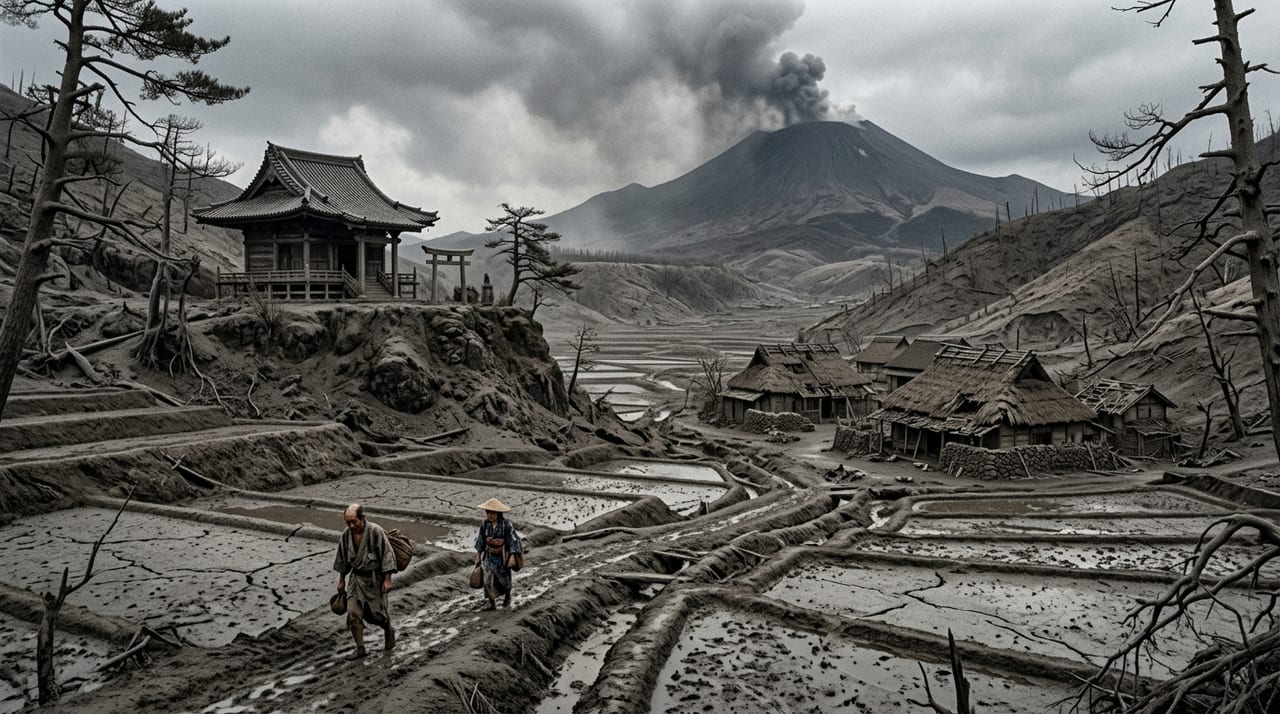
 * Image is for illustrative purposes only.
An'ei-Tenmei Famine Era
安永天明の飢饉期
The An'ei–Tenmei period, centered on the Great Tenmei Famine (1782–1787), was an era of natural disasters and social unrest that severely shook Japanese society. As swordsmiths struggled and their working conditions deteriorated, Suishinshi Masahide and others began to advocate a return to the ideals of old swords, quietly laying the ideological foundation of the Shinshintō period.
Description
The Great Tenmei Famine and the Collapse of Society
The Great Tenmei Famine, from Tenmei 2 (1782) through Tenmei 7 (1787), is known as the greatest famine of the Edo period. Crop damage from the great eruption of Mount Asama in Tenmei 3 (1783), cold-weather damage, and large-scale floods struck in succession, and the damage was especially severe in the Ōu region. The famine is said to have caused more than 900,000 deaths from starvation and disease across the country. This social and economic upheaval also hit swordsmiths directly. As the finances of samurai and daimyo households deteriorated, orders for swords plummeted, and many smiths were forced to give up their trade. Many local blacksmiths switched to producing farm tools, hoes, and sickles, and the lives of smiths who worked exclusively on swords were extremely hard.
The Emergence of Suishinshi Masahide
Although the An'ei–Tenmei period was, on the surface, a stagnant era for sword culture, a single gifted swordsmith, Suishinshi Masahide (1750–1825), was quietly forming his ideas. Masahide was a swordsmith from Dewa Province (Yamagata) who went to Edo to work. Continuing to make swords even in the difficult circumstances of the Tenmei period, Masahide was dissatisfied with the style of the shintō swords of his time and began a thorough study of old swords from the Kamakura and Nanboku-chō periods. His research bore fruit in writings such as Tōken Jitsuyō-ron and Tanren Gyokkan, establishing the ideological foundation of the shinshintō movement: the principle that one should "return to the techniques of old swords."
The Sword World on the Eve of the Shinshintō
The An'ei–Tenmei period falls at the end of the shintō era, and it is also the era of the "sue-shintō," when the vitality of Edo shintō (early to mid-Edo period) had been lost. Although there were many smiths, few were outstanding masters, and many works were mass-produced and lacked individuality. On the other hand, there is an argument that the "plain, practical swords" of this era reflect the realities of mid-Edo samurai society and hold a distinctive value that deserves reappraisal in later times.
The Tanuma Era and Sword Demand
What characterizes the An'ei–Tenmei period politically is the mercantilist policy (1772–1786) of the chief rōjū Tanuma Okitsugu. The Tanuma administration placed importance on commerce and trade, bringing about social change in which merchants gained more power than samurai. A tendency among wealthy merchants to collect swords was seen in some areas, but overall swords retained their character as symbols of samurai prestige, and the deterioration of samurai finances pushed down demand as a whole. The Tenmei riots (uchikowashi) of Tenmei 7 (1787), large-scale popular uprisings in Edo, symbolized the crisis of politics and society. Tanuma had already been removed from office the previous year, in Tenmei 6 (1786), and the Kansei Reforms led by Matsudaira Sadanobu began immediately after.
The Spread of the Uchigatana and the Transformation of Sword Culture
In the An'ei–Tenmei period, the standard way of wearing the uchigatana had become fully established. The daishō, a pair of two swords (the uchigatana and the wakizashi), was established as the standard equipment of samurai, and the tachi had already been positioned as a special sword for ceremonial dress and rituals. The everyday uchigatana of samurai in this period were mostly practical, sturdy but not necessarily high-quality mass-produced items, reflecting the economic difficulties of society as a whole. Craftsmen related to swords in Edo city, including togishi (polishers), shirogane-shi (silversmiths), saya-shi (scabbard makers), and tsukamaki-shi (hilt binders), also suffered from the economic slump during the famine.
The Current of Restorationist Thought
In the Kansei period (1789–1801) after the Tenmei famine, a restorationist ideology calling for a "return to good things of the past" rose across society, not only in the field of swords. The Kansei Reforms of Matsudaira Sadanobu embodied this spirit of the age, and in the field of swords, Suishinshi Masahide led the way in spreading the argument among smiths that they should "learn from the old swords of the Kamakura period." This idea led directly to the shinshintō movement, which blossomed in the Bunka–Bunsei period (1804–1830) that followed. The unprecedented hardship of the Great Tenmei Famine was, paradoxically, also a time that generated the spiritual energy that prompted the next evolution of the Japanese sword.
Characteristics of This Era
- The Sue-shintō era, in which the effects of famine and economic slump appeared directly in the quality of blades. Overall standards of craftsmanship declined, but these works have value as testimony to social history.
- Suishinshi Masahide begins the study of old swords: the ideological foundation of the later shinshintō movement was quietly formed in this difficult era. Hardship paradoxically encouraged deeper thought.
- The completion of the daishō culture of two swords: the pairing of the uchigatana and wakizashi became fully established as the symbol of samurai identity. The ceremonial and ritual function of swords completely outweighed their function as weapons.
- Commercialism under the Tanuma administration influenced sword collecting: wealthy merchants and rural landowners bought swords, but the deterioration of samurai finances pushed down overall demand.
- Restorationist orientation under the Kansei Reforms: the frugality policy and renewed emphasis on samurai morality of Matsudaira Sadanobu formed a cultural climate that served as a receptive ground for the shinshintō movement's ideal of returning to old swords.