Neuheiten — Aktuelle Neuzugänge finden Sie in unserem Katalog. Ansehen →
4.–20. März 1877 (Meiji 10)
Tabaruzaka, Provinz Higo (heute Ueki-machi, Kita-Bezirk, Kumamoto-Stadt, Präfektur Kumamoto)
Kräfte
Kaiserliche Regierungsarmee
Satsuma-Armee (Saigō-Truppen)
Etwa 17 Min. Lesedauer
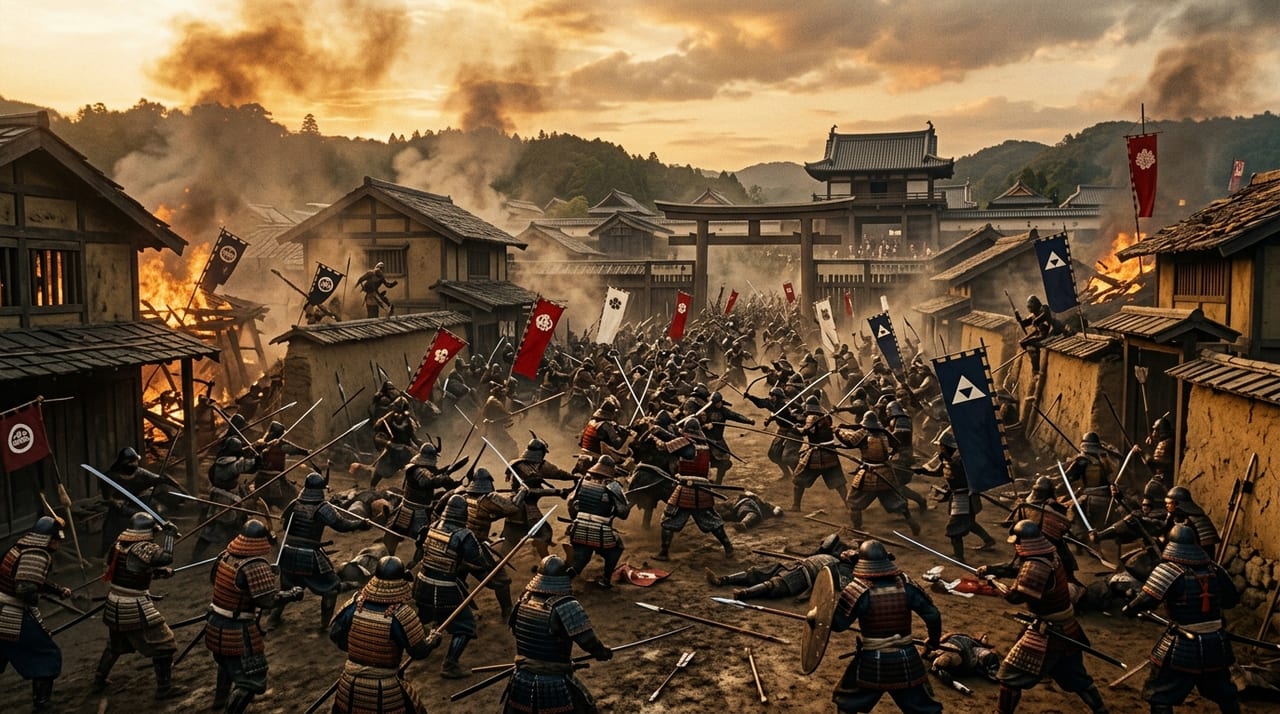
Die Schlacht von Tabaruzaka wurde über siebzehn Tage lang, vom 4. bis 20. März 1877 (Meiji 10), bei Tabaruzaka in der Provinz Higo (heute Ueki-machi, Kita-Bezirk, Kumamoto-Stadt, Präfektur Kumamoto) ausgetragen. Sie war das größte und verlustreichste Einzelgefecht des Satsuma-Aufstands.
Der Satsuma-Aufstand war ein bewaffneter Aufstand ehemaliger Samurai, angeführt von Schülern der privaten Akademien (shigakkō) von Kagoshima, die sich vom 29. Januar bis 24. September 1877 unter Saigō Takamori sammelten. Er war der größte einer Welle von Samurai-Aufständen in der frühen Meiji-Zeit und wird allgemein als Japans letzter Bürgerkrieg betrachtet.
Saigō Takamori trat von seinem Posten als Staatsrat zurück, nachdem er 1873 die Debatte über die geplante Invasion Koreas (Seikanron) verloren hatte, und kehrte nach Kagoshima zurück, gefolgt von ungefähr 600 Mitbeamten und Militäroffiziern aus Kagoshima, darunter Kirino Toshiaki, Shinohara Kunimoto und Beppu Shinsuke. Im Juni 1874 wurden die shigakkō (Privatakademien) – bestehend aus einer Gewehrschule und einer Artillerieschule für die Söhne der Samurai-Klasse – auf dem früheren Gelände der Burgstallungen von Kagoshima errichtet und wurden zum organisatorischen und spirituellen Zentrum einer großen Gruppe von Saigō treuer ehemaliger Samurai. Im Januar 1877 versuchte die neue Meiji-Regierung, besorgt über Unruhen in Kagoshima, heimlich Munition aus dem Arsenal Sōmuta zu entfernen; aufgebrachte Akademiestudenten überfielen daraufhin die Anlage und erbeuteten Waffen und Munition. Hinzu kamen Verdächtigungen über einen Regierungsplan zur Ermordung Saigōs, und Akademieführer überredeten ihn schließlich, einen bewaffneten Aufstand anzuführen – den unmittelbaren Auslöser des Satsuma-Aufstands.
Am 22. Februar 1877 startete die Satsuma-Armee unter Saigō Takamori einen Vollangriff auf die Burg Kumamoto, Sitz der Kumamoto-Garnison. Aber die von Katō Kiyomasa erbaute Festung erwies sich als übermächtig, und Tani Tateki, Oberbefehlshaber der Kumamoto-Garnison, lehnte Saigōs Bitte um freien Durchgang ab. Nach den Befehlen der neuen Regierung zu widerstehen, entschied er sich stattdessen für eine vollständige Belagerungsverteidigung. Innerhalb der Burg zerstörte ein Feuer am 19. Februar einen Lebensmittelvorrat für dreißig Tage, aber die Finanzbehörde der Garnison beschaffte am nächsten Tag weitere Lebensmittel für zwanzig Tage aus der Stadt und den umliegenden Dörfern. Dies ermöglichte es den Verteidigern, eine zweiundfünfzigtägige Belagerung durchzuhalten, bis sie von den herannahenden Regierungstruppen entlastet wurden. Um die Burg zu entlasten, entsandte die Regierung unter Kaiserlichem Prinz Arisugawa-no-miya Taruhito, dem Oberbefehlshaber der Unterdrückungskampagne, ein großes Expeditionskorps nach Kyūshū, wobei Generalleutnant Yamagata Aritomo die Feldoperationen befehligte. Um Kumamoto zu erreichen, musste dieses Entlastungskorps durch Tabaruzaka durchbrechen, einen strategischen Engpass auf der Straße von Takase (heute Tamana-Stadt) nach Kumamoto.
Tabaruzaka war einer der wenigen Wege, der Artillerie und schwere Wagen aufnehmen konnte, was ihn für beide Seiten von kritischer militärischer Bedeutung machte. Die Satsuma-Armee befestigte dort starke Verteidigungspositionen, um den Regierungsvormarsch auf Kumamoto zu blockieren.
Auf dem Kumamoto-Schauplatz des Satsuma-Aufstands wurden neben Tabaruzaka auch Yokobira-yama und der Kichiji-Pass zu Stätten erbitterter Kämpfe. Seit der Edo-Zeit wurde dieses Gebiet von der Buzen-Straße, der Miike-Straße und der Kichiji-Straße durchquert; mit ihrem Hauptquartier in Hakata musste die Regierung einen dieser drei Wege durchbrechen, sowohl um die nach Norden vorrückende Satsuma-Armee zu unterdrücken als auch um Verstärkungen zur Burg Kumamoto zu schicken. Wenn Tabaruzaka die Hauptroute darstellte, war der Kichiji-Pass eine Nebenroute, und die Regierung teilte ihre Truppen bei Takase auf, um gleichzeitig Tabaruzaka und den Kichiji-Pass anzugreifen. Die Kämpfe am Kichiji-Pass dauerten tatsächlich länger als in Tabaruzaka, und erbitterte Kämpfe setzten sich im benachbarten Dorf Kidome fort, selbst nachdem die Regierungstruppen in Tabaruzaka selbst durchgebrochen waren.
Die Vollkampfhandlungen begannen am 4. März 1877 und setzten sich in wechselnden Gefechten siebzehn Tage lang bis zum 20. fort. Obwohl die Regierungstruppen die Satsuma-Armee zahlenmäßig weit übertrafen und eine überlegene Feuerkraft besaßen, überrannten Satsuma-Truppen – angeführt von Offizieren mit Samurai-Hintergrund und trainiert in Techniken wie dem Satsuma Jigen-ryū-Schwertkampf – wiederholt Regierungseinheiten im Nahkampf und bei Schwertangriffen. Die meisten Regierungssoldaten, ausgehobene Bürger unter dem neuen Wehrpflichtgesetz, verfügten nicht über vergleichbare Schwertausbildung.
Die Regierungstruppen verloren allein am 20. März 495 Gefallene, und ihre Gesamtzahl an Gefallenen an der Tabaru-Front seit dem 4. März erreichte 2.401. Über den gesamten Aufstand hinweg werden kombinierte Verluste auf beiden Seiten auf über 14.000 Tote geschätzt, und auf dem Höhepunkt der Kämpfe in Tabaruzaka wurden Berichten zufolge bis zu 320.000 Schuss Munition an einem Tag verbraucht. Tage heftigen Regens verschärften die Brutalität der Kämpfe und zwangen beide Seiten in einen zermürbenden Abnutzungskrieg im Schlamm – eine Mühsal, die später im Volkslied ‚Tabaruzaka' verewigt wurde, das mit der Zeile ‚der Regen fällt und fällt, durchnässt Menschen und Pferde gleichermaßen' beginnt.
Um Satsumas Nahkampf- und Schwertangriffstaktiken entgegenzuwirken, beantragten hochrangige Polizeibeamte Satsuma-Ursprungs – darunter Kawabata Tanenaga, Ueda Yoshisada und Sonoda Yasukata – bei Yamagata Aritomo, eine spezielle Einheit von Schwertkämpfern aus den Reihen der Polizei (keishi-tai) zu bilden, die dem Ueki-Sektor zugewiesen wurde. Yamagata billigte den Vorschlag und benannte die Einheit ‚Battōtai' (Korps der gezogenen Schwerter) und wählte ungefähr 110 geschickte Schwertkämpfer aus, um die erste Kompanie zu bilden.
In der Frühe des 14. März 1877 startete die Battōtai einen überraschenden Schwertangriff gegen Satsuma-Positionen und erzielte einen bedeutenden Erfolg, der sich als entscheidender Wendepunkt in der Kampagne zum Durchbruch von Tabaruzaka erwies.
Die Leistung der Battōtai hatte besonderes symbolisches Gewicht angesichts des breiteren Status des japanischen Schwertes zu dieser Zeit. Das Schwert-Abolitions-Edikt von 1876 (Haitōrei) hatte das Tragen von Schwertern verboten, mit Ausnahme von Militär- und Polizeipersonal, was zu einem Zusammenbruch der Nachfrage nach japanischen Schwertern führte; das modernisierende Militär, das westlichen Modellen folgte, hatte auch dazu geneigt, westliche Säbel an Stelle von Schwertern zu übernehmen. Doch der Erfolg der Battōtai im Nahkampf in Tabaruzaka bewies, dass die Schwertkampfkunst mit dem traditionellen japanischen Schwert echten praktischen Wert behielt, selbst im Zeitalter moderner Feuerwaffen. Dies trug zu einer erneuerten Wertschätzung des Schwertes als ernsthafte Waffe statt als obsoletes Relikt bei. Die Battōtai wurde später im Militärlied ‚Battōtai' (Text von Toyama Masakazu, Musik von Charles Leroux) verewigt, das der Einheit bleibenden Ruhm brachte.
Am 20. März durchbrachen die Regierungstruppen schließlich die Satsuma-Verteidigungen in Tabaruzaka und sicherten die Route zur Burg Kumamoto. Die Belagerung der Burg wurde bald darauf aufgehoben, und die Satsuma-Armee zog sich nach wiederholten Niederlagen stetig nach Süden zurück. Der Aufstand endete letztendlich am 24. September 1877, als Saigō Takamori sein Leben in Shiroyama in Kagoshima beendete.
Die Schlacht von Tabaruzaka wird häufig in der Geschichte des japanischen Schwertes zitiert als jenes Ereignis, in dem der praktische und kulturelle Wert des Schwertes – unter dem Schwert-Abolitions-Edikt vom Aussterben bedroht – paradoxerweise durch Nahkampf in Japans letztem Bürgerkrieg bekräftigt wurde. Im Gefolge der Schlacht wurde die Schwertkunst bei der Polizei gefördert (Kawaji Toshiyoshis Schrift Gekken Saikōron und die Begründung des Keishi-ryū-Schwertstils), und die Schlacht gilt als einer der entscheidenden Momente für das Fortbestehen der japanischen Schwertkultur in der Moderne.
Die Stätte dieser erbitterten Kämpfe wird heute als Tabaruzaka-Park in Ueki-machi, Kita-Bezirk, Kumamoto-Stadt, bewahrt und beherbergt das Tabaruzaka-Seinan-Kriegsmuseum, das 2015 (Heisei 27) unter dem Konzept einer ‚historischen Lerneinrichtung, die die Morgenröte des modernen Japan lehrt und überträgt' renoviert wurde. Der Park umfasst das ‚Haus der Einschusslöcher' (Dankon no Ie), ein rekonstruiertes, von Einschüssen übersätes Speicherhaus, sowie einen Gedenkturm. Das Museum zeigt Schwerter und Feuerwaffen, die tatsächlich in den Kämpfen verwendet wurden, ausgegrabene Kugeln und Listen der Gefallenen und hält damit die Erinnerung an die größte Schlacht des Satsuma-Aufstands lebendig. Am 27. März 2013 (Heisei 25) wurde das Gebiet einschließlich Tabaruzaka als nationale historische Stätte ‚Stätten des Seinan-Krieges' ausgewiesen; geschützt sind rund 193.000 Quadratmeter in der Gemeinde Gyokutō und der Stadt Kumamoto. Tabaruzaka selbst soll ein Hangweg aus drei Abschnitten – Ichi-no-saka, Ni-no-saka und San-no-saka – von etwa 4 Metern Breite und etwa 1,5 Kilometern Länge gewesen sein.