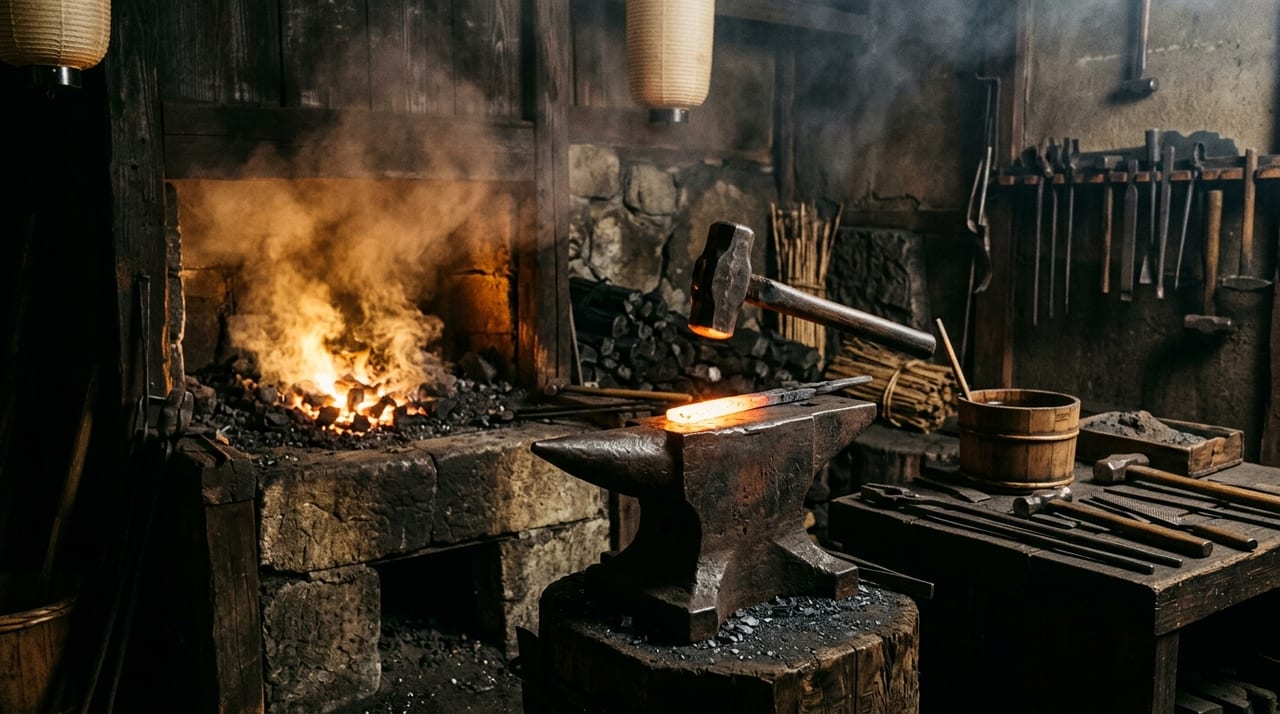
※圖片為示意圖。Miyamoto Kanenori
宮本包則
Description
Origins and Apprenticeship under Yokoyama Sukekane
Miyamoto Kanenori (1830-1926) was born in 1830 (Tenpo 1) in Ohagaki, Hoki Province (present-day area near Kurayoshi, Tottori Prefecture), the second son of a sake brewery owner. His childhood name was Shigahiko. Inspired by the legendary local master swordsmith Yasutsuna (Hoki Yasutsuna), he set his heart on becoming a swordsmith. In 1851, at age 22, he traveled to Osafune in Bizen Province (present-day Setouchi, Okayama Prefecture) and apprenticed under Yokoyama Sukekane. According to Japanese Wikipedia and Touken World, he is said to have first been turned away by another Osafune master, Yokoyama Sukenaga, before being accepted by Sukekane. Over seven years of training he thoroughly mastered the techniques of the Bizen tradition, and it was from this relationship that he received the character "kane" (包) used in his professional name, Kanenori.
Bakumatsu Activity and the Boshin War
In 1857 he became a retained swordsmith of the Tottori domain. In 1863 he established his own forge at Sanjo Horikawa in Kyoto, producing blades on commission for domain samurai active in the Sonno Joi (revere the emperor, expel the barbarians) movement. Under the patronage of Imperial Prince Arisugawa-no-miya Taruhito, he was granted the honorary title of Noto-no-kami in 1867. During the turmoil of the Boshin War he forged swords in support of the Imperial loyalist forces, and undertook a period of ritual seclusion at Fushimi Inari Taisha shrine to produce dedicatory blades — activity that cemented his standing as a swordsmith during the chaotic final years of the shogunate.
A Style Fusing the Bizen and Mino Traditions
Kanenori's work is built on the Bizen Osafune Kanemitsu style inherited from his teacher Yokoyama Sukekane, but is distinguished by its fusion of Bizen-den and Mino-den elements. His steel is characterized by a fine, tightly forged ko-itame grain, and his hamon are elegant yet unpretentious, occasionally displaying the bold vigor reminiscent of Soshu master Masamune. This eclectic style allowed him to carry the classical technical foundations of the Bizen tradition into the modern era while adapting to the changing demand for swords across the Bakumatsu-to-Meiji transition.
Appointment as Imperial Household Artist and Service to the Throne
In April 1906 (Meiji 39), Miyamoto Kanenori and Gassan Sadakazu became the first swordsmiths ever appointed Teishitsu Gigeiin (Imperial Household Artist) — a title created to preserve traditional crafts amid Japan's modernization, and the direct forerunner of today's Living National Treasure (Important Intangible Cultural Property holder) system. For the 1915 enthronement ceremony of Emperor Taisho he was commissioned to forge the Grand Marshal's sword, and he also produced protective swords for the Sessho-no-miya (the future Emperor Showa) and Prince Chichibu, as well as ceremonial treasure swords for the Ise Grand Shrine's periodic rebuilding rites and for Heian Jingu and Meiji Jingu shrines. He is regarded as the last court swordsmith to have served four successive emperors — Komei, Meiji, Taisho, and Showa.
Longevity and Historical Significance
Miyamoto Kanenori continued forging swords until his death on October 24, 1926, at the age of 97. His career of roughly 75 years — from his apprenticeship at 22 through the turbulence of the late Edo period, the modernization of the Meiji era, and the imperial ceremonies of the Taisho and early Showa periods — represents a rare case of a swordsmith active across one of the most transformative eras in Japanese sword history. His faithful transmission of Bizen-den technique enriched by elements of Mino-den, together with his status as one of the first two swordsmiths ever named Imperial Household Artist, secures Miyamoto Kanenori's importance in the history of modern Japanese swordmaking. He is buried at Somei Cemetery in Tokyo.
Famous Works
- 大正天皇御大典 大元帥刀(1915年)
- 伊勢神宮式年遷宮 神宝太刀(1886年)