最新消息 — 最新入荷資訊請查閱商品目錄。 查看 →
August 17, 1863 (Bunkyū 3)
Gojō, Yamato Province (present-day Gojō City, Nara Prefecture); Takatori Castle; Totsukawa; Washika Pass
約11分鐘閱讀
In 1863 (Bunkyū 3), radical nobles and activists of the sonnō jōi ("revere the emperor, expel the barbarians") faction, centered on Chōshū domain, briefly held strong influence at the imperial court in Kyoto. They succeeded in obtaining an imperial edict for a "Yamato Procession," under which Emperor Kōmei himself would visit the mausoleum of Emperor Jinmu in Yamato Province to pray for the expulsion of foreigners. Far from a mere religious ceremony, the plan was meant to place the emperor personally at the head of the anti-foreign movement, pressuring the shogunate to reverse its policy of opening the country and effectively launching a movement to overthrow the bakufu.
Seizing this moment, a band calling itself the Tenchūgumi ("Heaven's Avengers") formed under the command of the court noble Nakayama Tadamitsu, then 22 and a chamberlain, with the rōnin Yoshimura Toratarō (who had fled Tosa domain), the Confucian scholar Matsumoto Keidō, and the painter-turned-activist Fujimoto Tesseki serving as directors. Their aim was to seize shogunate-held territory in Yamato ahead of the imperial procession and secure a base for the pro-court cause. On August 14 they proclaimed their uprising at Hōkō-ji temple in Kyoto, then marched south through Osaka and Sakai along the Kōya road into Yamato. The group numbered only around forty at the outset, including nineteen Tosa exiles led by Yoshimura.
On the afternoon of August 17, the Tenchūgumi attacked the shogunate magistrate's office at Gojō in Yamato Province (present-day Gojō City, Nara Prefecture), which administered directly-held bakufu territory, killing the magistrate Suzuki Masanobu and four others and seizing the office. The next day they declared the surrounding shogunate lands to be under direct imperial administration and announced a fifty-percent reduction of that year's annual tax. This went beyond mere armed uprising, carrying elements of a genuine governing experiment aimed at winning local support. At this stage, allies such as the Kawachi landowner Nikōri Zennosuke joined the group, temporarily swelling its ranks.
The Tenchūgumi's fortunes turned almost immediately, however, when a political coup struck Kyoto. On August 18, the kōbu-gattai (court-shogunate cooperation) faction, led by Aizu and Satsuma domains, regained the upper hand at court; radical sonjō nobles such as Sanjō Sanetomi were expelled from the capital, and the Yamato Procession itself was cancelled. Having risen in arms as the vanguard of that very procession, the Tenchūgumi lost its claim to legitimacy overnight and became, in the eyes of the court and shogunate alike, a band of rebels.
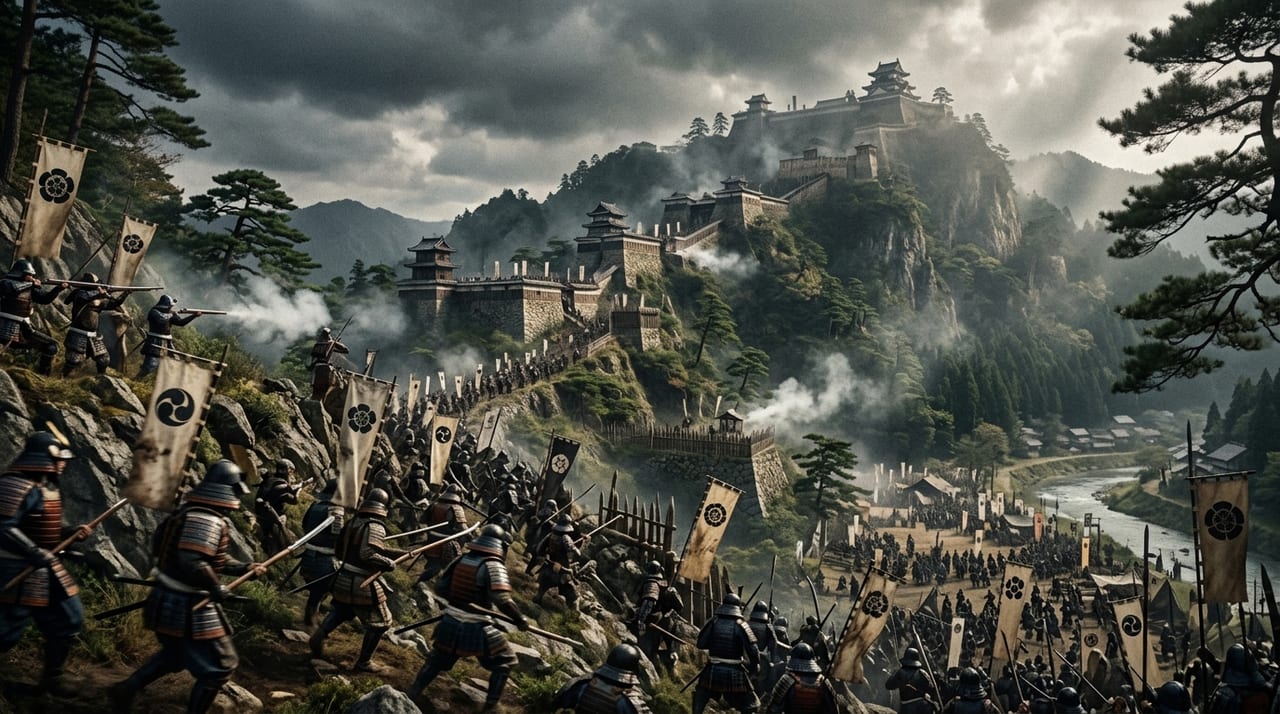
Stripped of court backing, the group nonetheless attempted to expand its foothold in Yamato, assaulting Takatori Castle, a subsidiary fortress of Yamato-Kōriyama domain, on August 25–26. The castle's defense proved far stronger than expected, and the attack failed, with director Yoshimura Toratarō wounded by gunfire.
After the failed assault on Takatori Castle, the Tenchūgumi found itself encircled by an overwhelming punitive force of roughly 14,000 men mobilized from Kishū, Tsu, Hikone, and other domains at the shogunate's order. The group retreated into the mountainous Totsukawa district, where several hundred local militia (Totsukawa gōshi) initially joined their resistance. As the militia realized how hopeless the situation had become, however, they defected one after another, making organized resistance increasingly impossible.
From September 24 to 27, the surviving Tenchūgumi fighters made their last stand against the punitive forces at Washika Pass in Yamato Province (present-day Higashiyoshino Village, Nara Prefecture). Nasu Shingo and Shishido Yashirō were killed in the fighting, followed by Matsumoto Keidō and Fujimoto Tesseki. Yoshimura Toratarō, gravely wounded, was discovered by the pursuing forces on the 27th and is said to have met his end on the spot. Commander Nakayama Tadamitsu, protected by his retainers, narrowly escaped the battlefield and fled via Osaka to Chōshū domain, only to be assassinated by Chōshū retainers amid internal domain strife in November 1864.
Though it lasted barely forty days from uprising to annihilation, the Tenchūgumi Incident holds an important place in Bakumatsu history as one of the earliest instances in which the sonnō jōi movement moved beyond petitions and rhetoric into armed insurrection. The severed heads of its leaders were displayed at Awataguchi in Kyoto that October, and the shogunate treated the group at the time as unambiguous rebels.
After the Meiji Restoration, however, the assessment of the Tenchūgumi shifted dramatically. The new Meiji government reappraised them as loyalists who had died for the imperial cause, and from 1883 onward the fallen were enshrined at Yasukuni Shrine and posthumous court ranks were bestowed on participants and their descendants. Today the incident is remembered as a "forerunner of the Restoration," and Gojō City and Higashiyoshino Village in Nara Prefecture still preserve numerous sites and memorial markers connected to the uprising.
Various records and local traditions describe hand-to-hand fighting with drawn blades during the attack on the magistrate's office, the assault on Takatori Castle, and the final battle at Washika Pass. Most of the swords carried by Bakumatsu-era activists were shinshintō blades forged by smiths active around Osaka and Kyoto, favoring practical, durable construction and portability suited to actual combat over decorative flourish. The last stand of the Tenchūgumi survivors at Washika Pass, fought sword in hand to the very end, is often cited by later researchers as a representative example of the relationship between the samurai/activist class and the Japanese sword during the turmoil of the Bakumatsu period.