Neuheiten — Aktuelle Neuzugänge finden Sie in unserem Katalog. Ansehen →
19. Tag des 3. Monats, Tenbun 17 (1548)
Azukizaka, Distrikt Nukata, Provinz Mikawa (heute um Hane-chō und Miai-chō, Stadt Okazaki, Präfektur Aichi)
Kräfte
Verbündete Armee von Imagawa und Matsudaira
Oda-Armee
Etwa 16 Min. Lesedauer
Die Schlacht von Azukizaka (Azukizaka no tatakai) war ein Gefecht, das am 19. Tag des 3. Monats von Tenbun 17 (1548) in Azukizaka im Distrikt Nukata der Provinz Mikawa (um Hane-chō und Miai-chō, Stadt Okazaki, Präfektur Aichi) stattfand. Dort trafen die Streitkräfte von Oda Nobuhide aus der Provinz Owari auf jene von Imagawa Yoshimoto, der nach der Herrschaft über Suruga, Tōtōmi und Mikawa strebte. Es wird überliefert, dass beide Parteien an demselben Ort bereits im Jahr Tenbun 11 (1542) aufeinandertrafen. Da die Quellen zwei Schlachten von Azukizaka nennen, wird die Schlacht von 1548 auch als „Zweite Schlacht von Azukizaka“ bezeichnet.
Matsudaira Hirotada, der Herr von Burg Okazaki in der Provinz Mikawa, stand unter dem Druck der Expansion Oda Nobuhides aus dem Nachbarland Owari und war zugleich auf die Unterstützung Imagawa Yoshimotos aus Suruga angewiesen. Sein Vater Matsudaira Kiyoyasu hatte seinen Einfluss im Jahr Taiei 4 (1524) so weit ausgedehnt, dass er Burg Okazaki einnahm und Ost- und West-Mikawa nahezu in seiner Hand vereinte. Im Jahr Tenbun 4 (1535) brach er jedoch zu einem Feldzug nach Moriyama in Owari auf, um Oda Nobuhide anzugreifen, und wurde dort von seinen eigenen Vasallen ermordet. Dieses Ereignis ist als Moriyama Kuzure bekannt. Danach verfiel die Macht des Hauses Matsudaira rasch.
Hirotada, der die Nachfolge antrat, verstärkte unter unsicheren Machtverhältnissen seine Abhängigkeit von den Imagawa. Im Jahr Tenbun 16 (1547) sollte sein Sohn Takechiyo (später Tokugawa Ieyasu) als Geisel zu den Imagawa geschickt werden. Auf dem Weg dorthin verriet ihn Toda Yasumitsu, der mit der Eskorte betraut war, und Takechiyo fiel in die Hände der Oda (Entführung während des Transports als Geisel zu den Imagawa).
Unter diesen Umständen strebte Oda Nobuhide nach einer Ausweitung seines Einflusses in Mikawa und plante die Eroberung von Burg Okazaki. Imagawa Yoshimoto entsandte, um die Matsudaira zu unterstützen und den Anspruch auf Mikawa zu sichern, ein großes Heer nach Mikawa, mit dem Strategen Taigen Sessai als Oberbefehlshaber.
Die Kämpfe an diesem Ort werden auch für das Jahr Tenbun 11 (1542), sechs Jahre vor 1548, überliefert. Damals war das Haus Matsudaira, dessen Oberhaupt Matsudaira Kiyoyasu nach dem Moriyama Kuzure im Jahr Tenbun 4 (1535) gewaltsam ums Leben gekommen war, bereits stark geschwächt. Diese Lücke nutzte Oda Nobuhide, um nach Westmikawa vorzudringen. Imagawa Yoshimoto, der die Matsudaira unterstützte, schickte dagegen ein großes Heer, um die Oda aus Westmikawa zu vertreiben. Im 8. Monat von Tenbun 11 (1542) (entspricht dem 9. Monat des gregorianischen Kalenders) trafen beide Heere südöstlich von Burg Okazaki am Azukizaka aufeinander.
In dieser ersten Schlacht zeichneten sich sieben Krieger auf Seiten der Oda aus: Oda Nobumitsu, Oda Nobufusa, Okada Shigeyoshi, Sassa Masatsugu, Sassa Magosuke, Nakano Kazuyasu und Shimokata Sadakiyo. Sie wurden später als „die Sieben Lanzen von Azukizaka“ gerühmt. Nach der Überlieferung errang die Seite der Oda durch ihre Tapferkeit den Sieg. Es gibt jedoch wissenschaftliche Hinweise darauf, dass der Vorstoß der Imagawa nach Ostmikawa tatsächlich erst ab dem Jahr Tenbun 12 (1543) erfolgte, weshalb die historische Glaubwürdigkeit der ersten Schlacht angezweifelt wird. Unabhängig davon ist die Schlacht von Tenbun 17 als Revanche der Imagawa für die Niederlage von vor sechs Jahren angelegt.
Im 3. Monat von Tenbun 17 (1548) führte Oda Nobuhide seinen ältesten nichtehelichen Sohn Oda Nobuhiro als Vorhut an. Er zog mit mehr als 4.000 Mann aus dem Stammland Owari über Burg Anjō, überquerte den Fluss Yahagi und lagerte in Kamiwada. Imagawa Yoshimoto stellte ihm ein Heer von rund 10.000 Mann entgegen, mit Taigen Sessai als Oberbefehlshaber und Asahina Yasuyoshi als stellvertretendem Befehlshaber.
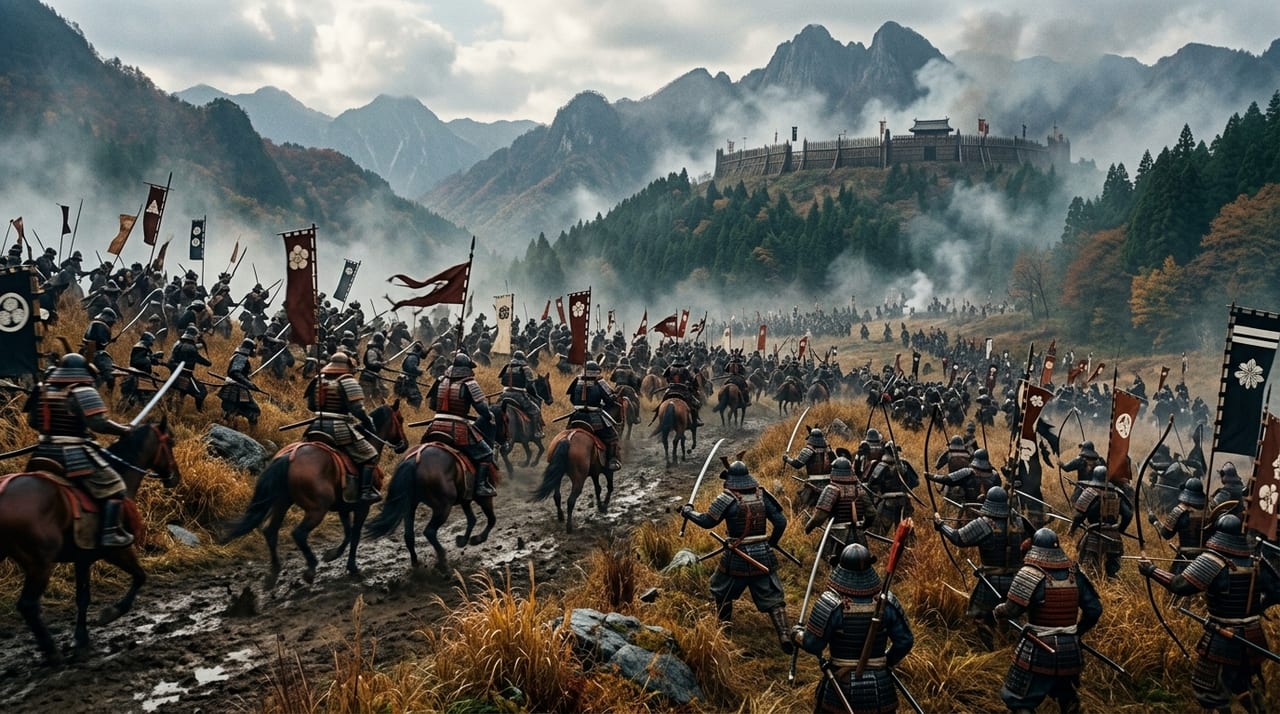
Am 19. Tag des 3. Monats von Tenbun 17 (1548) traf die Vorhut der Imagawa in Azukizaka auf die Vorhut der Oda unter Nobuhiro. Die Truppen der Imagawa hatten ihr Lager auf dem Gipfelbereich des Hügels aufgeschlagen und besaßen damit einen Geländevorteil. Sie stürmten den Hang herab und warfen die Vorhut der Oda zurück. Nobuhiros Truppen wichen bis in die Nähe von Nusumigi zurück, wo die Hauptstreitmacht Nobuhides stand, vereinigten sich mit ihr, gewannen wieder an Schwung und brachen das Matsudaira-Kontingent. Eine im Hinterhalt liegende Einheit der Imagawa griff jedoch die Hauptstreitmacht der Oda in die Flanke, woraufhin die Truppen der Oda völlig zusammenbrachen. Sie überquerten den Yahagi und flohen zurück nach Burg Anjō.
In dieser Schlacht kämpfte Okabe Motonobu (auch Naganori) mit großer Tapferkeit und trug entscheidend zum Sieg der Imagawa bei. Im Jahr Eiroku 3 (1560) verteidigte er in der Schlacht von Okehazama die vorderste Festung, Burg Narumi, und übergab sie erst nach dem Tod seines Herrn gegen die Herausgabe von dessen Haupt. Dies machte ihn als standhaften Krieger berühmt.
Die Schlacht endete mit einem überwältigenden Sieg der Imagawa. Die Kriegskunst Taigen Sessais – der Angriff aus der Flanke mit einem Hinterhalt und die Nutzung des Geländes bei der Aufstellung – war der entscheidende Faktor für die Niederlage der Truppen der Oda und festigte Sessais militärisches Ansehen bei den Imagawa.
Nach dem Krieg erweiterten die Imagawa ihren Einfluss in Mikawa erheblich, und ihre Herrschaft umfasste Suruga, Tōtōmi und Mikawa. Matsudaira Hirotada verstärkte seine Unterordnung unter die Imagawa weiter, und Takechiyo (Tokugawa Ieyasu) verbrachte deshalb eine lange Zeit als Geisel in Sunpu. Es wird auch die Ansicht vertreten, dass diese Jahre als Geisel bei den Imagawa Ieyasus Geduld und sein außenpolitisches Gespür geprägt haben.
Der Verrat Toda Yasumitsus, durch den Takechiyo an die Oda fiel, geschah zwar bereits im Vorjahr, doch seine Nachwirkungen wurden erst im Jahr Tenbun 18 (1549) beigelegt, ein Jahr nach der Schlacht von Azukizaka. Im 3. Monat von Tenbun 18 (1549) starb Hirotada (es heißt, an Krankheit oder durch die Hand seiner Vasallen). Daraufhin übernahm Imagawa Yoshimoto unverzüglich Burg Okazaki. Im 11. Monat von Tenbun 18 (1549) eroberten die Imagawa Burg Anjō, den Stützpunkt der Oda, und nahmen Oda Nobuhiro gefangen, den nichtehelichen Sohn Nobuhides, der bei Azukizaka die Vorhut geführt hatte. Die Imagawa erreichten einen Gefangenenaustausch zwischen Nobuhiro und Takechiyo, und Takechiyo wurde schließlich den Imagawa übergeben. Der Mann, der bei Azukizaka geschlagen floh, war damit ein Jahr später selbst an der Entscheidung über das Schicksal Mikawas beteiligt.
Die Schlacht von Azukizaka gilt als Spiegel der Kriegswirren des Sengoku-Zeitalters in den Heimatregionen Ieyasus, Mikawa und Owari. In der Geschichte des Sengoku wird sie als eines der Beispiele für den praktischen Einsatz von Uchigatana und Tachi durch die lokalen Kriegerverbände angeführt. Die Vorherrschaft der Imagawa in Mikawa war ein wichtiger Abschnitt im Ringen um Mikawa, das schließlich zur Schlacht von Okehazama (1560) führte. Dort lösten sich die Matsudaira (Tokugawa) von den Imagawa und gewannen die Unabhängigkeit von Burg Okazaki zurück.
Auch Taigen Sessai selbst ist bemerkenswert. Als Zen-Mönch der Rinzai-Schule leitete er die militärischen und diplomatischen Angelegenheiten der Imagawa, was selten war. Yoshimoto wurde in seiner Kindheit ins Kloster geschickt und studierte gemeinsam mit Sessai (damaliger Mönchsname: Kyūei Shōgiku) in Kyōto. Im Jahr Tenbun 5 (1536) starben kurz nacheinander Imagawa Ujiteru und Hikogorō. Im daraus entstandenen Erbfolgestreit, der Hanakura-Rebellion, eroberte Yoshimotos Seite auf Sessais Rat Burg Hanakura, in der sich sein älterer Halbbruder Genkō Etan verschanzt hatte. Etan wurde zum Selbstmord gezwungen, und Yoshimoto konnte nach seiner Rückkehr ins weltliche Leben die Nachfolge antreten. Für dieses Verdienst vertraute Yoshimoto Sessai als höchstem Berater in Politik und Militär tief. Im Jahr Tenbun 23 (1554) bemühte sich Sessai zudem um das Kō-Sō-Sun-Dreibündnis zwischen Takeda Harunobu (Shingen) und Hōjō Ujiyasu. Dadurch sicherte er der Imagawa den Rücken und ermöglichte die Konzentration der Kräfte im Westen (Mikawa und Owari). Der Sieg bei Azukizaka war einer der Anlässe, durch die Sessais Kriegskunst in Mikawa und darüber hinaus eindrucksvoll bekannt wurde. Er gilt als Wendepunkt auf dem Weg, auf dem Imagawa Yoshimoto zum „größten Bogenschützen des Kaidō“ aufstieg.
Das Schlachtfeld von Azukizaka wird heute in der Umgebung von Hane-chō und Miai-chō, Stadt Okazaki, Präfektur Aichi, verortet. In der Gegend stehen Gedenksteine und Informationstafeln, die an die Schlacht erinnern. Der Ortsname „Azukizaka“ ist bis heute erhalten und bildet eine wertvolle Erinnerungsstätte an die Auseinandersetzungen um Mikawa in der frühen Sengoku-Zeit. Dass an demselben Hang zweimal, in der ersten und in der zweiten Schlacht, gekämpft wurde, macht das Gelände zu einem Ort, der sowohl für die regionale Geschichtsforschung als auch für die Forschung zu Tokugawa Ieyasu von Bedeutung ist. Er bewahrt die Spannungen zwischen Oda und Imagawa in der Grenzregion von Owari und Mikawa, einem strategisch wichtigen Knotenpunkt.