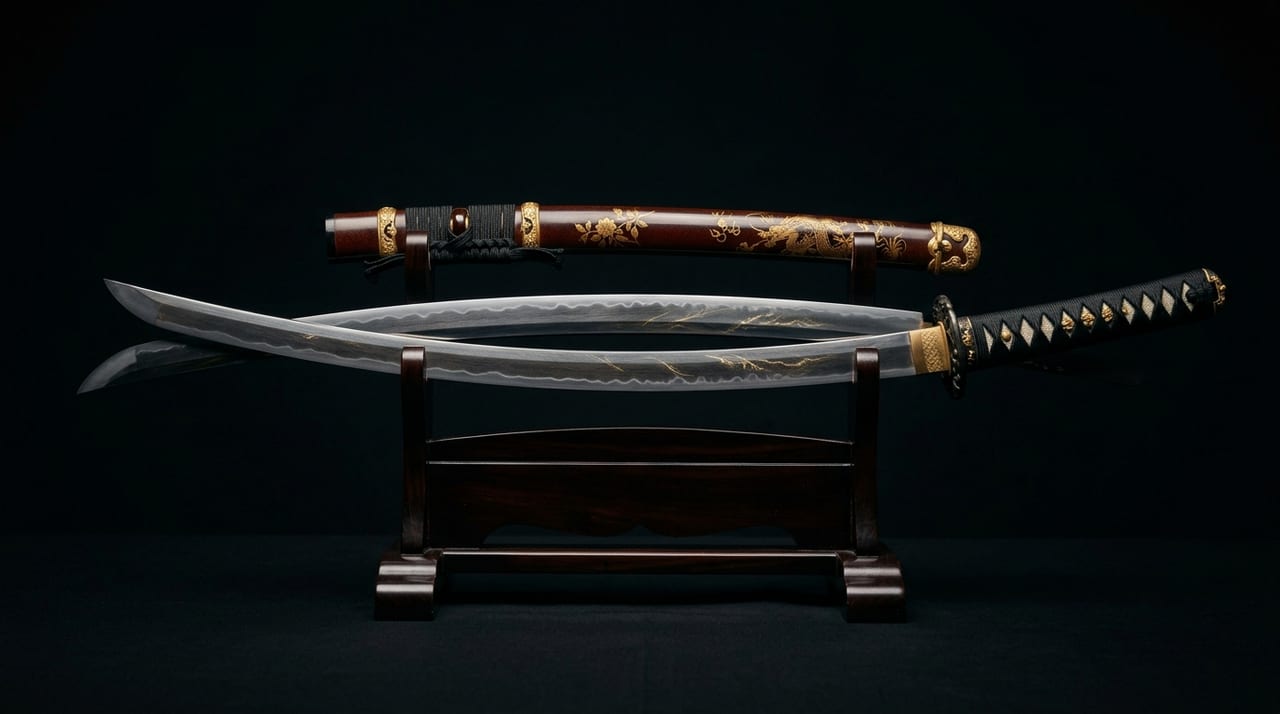
※圖片為示意圖。Chokutō of Kashima Jingu
鹿島神宮直刀
別名: Chokutō, Black-Lacquer Hyōmon Tachi Koshirae (with sword chest); the largest surviving chokutō
解說
Overview
An unsigned chokutō (straight sword) preserved at Kashima Jingu Shrine in Kashima, Ibaraki Prefecture. Its official designation name is "Chokutō, Black-Lacquer Hyōmon Tachi Koshirae (with sword storage chest)." It was designated a National Treasure (fine art) on June 22, 1955. The blade is dated to the late Nara through Heian period, while the accompanying mounting (koshirae) is attributed to the early Heian period.
Dimensions and Craftsmanship
The blade measures 223.3–223.4 cm in length, making it the largest surviving chokutō in Japan. It has an extremely slight curvature of only 0.6–0.7 cm, retaining an almost perfectly straight profile, with a base width of roughly 5 cm. The steel and temper are of excellent quality, judged comparable in workmanship to the imperial sword treasures preserved at the Shōsōin Repository.
Koshirae (Mounting)
The accompanying tachi koshirae has a black-lacquered hilt and scabbard decorated with gilt-bronze fittings in the hyōmon (flat metal inlay) technique, engraved with auspicious cloud and hōsōge arabesque motifs, dated to the early Heian period. The mounting measures 270.2 cm in total length, with a scabbard of 228.1 cm.
Provenance and Current Holding
The sword has been enshrined as the sacred blade of Takemikazuchi-no-Ōkami, the deity of Kashima Jingu, and preserved within the shrine since ancient times. A connection has been noted with iron-sand deposits of the Kashima region recorded in the Hitachi no Kuni Fudoki, an 8th-century regional gazetteer. It is held today in the Kashima Jingu treasure hall, which has remained closed to the public since 2018.
逸話與傳說
The chokutō is traditionally venerated as the sacred sword of Takemikazuchi-no-Ōkami, the deity enshrined at Kashima Jingu. In the Kojiki and Nihon Shoki myth cycles, Takemikazuchi is the warrior deity dispatched to negotiate the "transfer of the land" (kuni-yuzuri), and this blade, regarded as his sacred sword, has been carefully preserved as a treasure of the shrine. The 8th-century Hitachi no Kuni Fudoki also records iron-sand production in the Kashima region, which has been suggested as connected to the sword's manufacture.