最新消息 — 最新入荷資訊請查閱商品目錄。 查看 →
September 13–14, 1600 (Keichō 5)
Ishigakibaru, Hayami District, Bungo Province (present-day Beppu City, Ōita Prefecture)
勢力
Kuroda army (Eastern Army faction)
Ōtomo army (Western Army faction)
約16分鐘閱讀
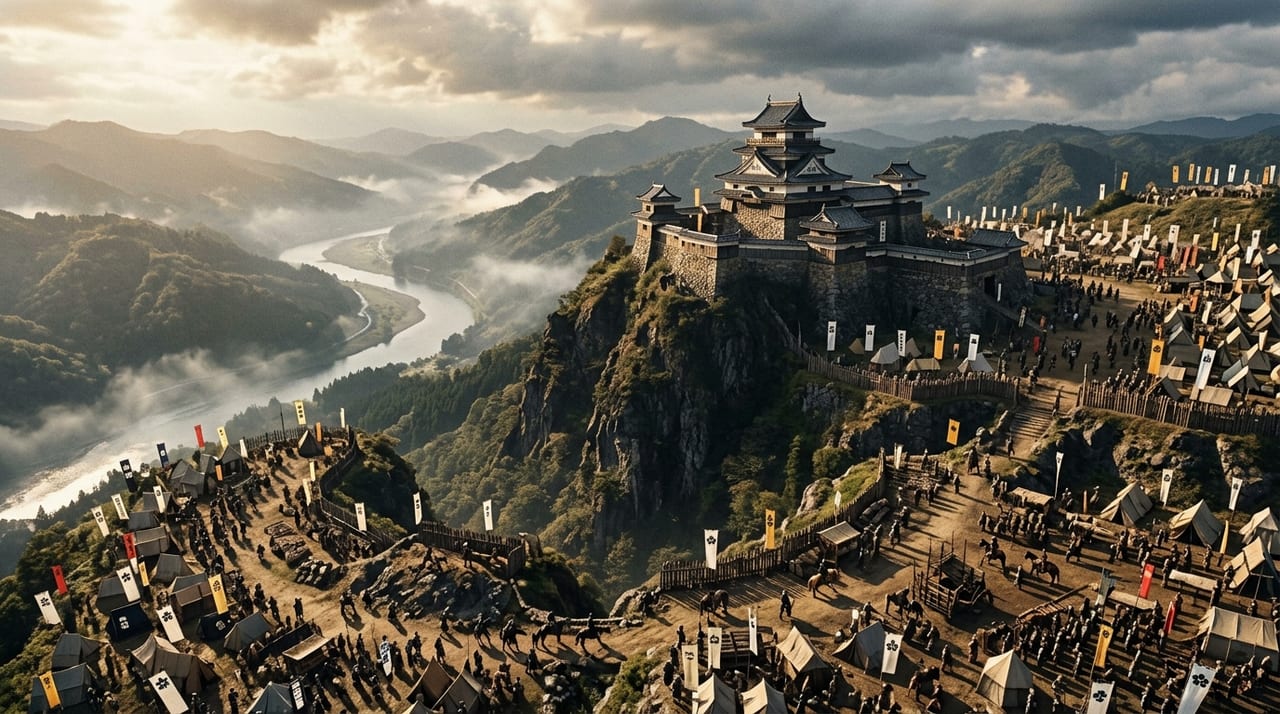
The Battle of Ishigakibaru was fought on September 13–14, 1600 (Keichō 5), at Ishigakibaru in Hayami District, Bungo Province (present-day Beppu City, Ōita Prefecture). Occurring just one to two days before the main Battle of Sekigahara (September 15), it is often called the "Sekigahara of Kyūshū" or the "Western Sekigahara."
The Ōtomo clan originated in Sagami Province in the early Kamakura period and, after being appointed jitō (land steward) and shugo (military governor) of Bungo Province, grew into a powerful daimyo house controlling Bungo, Buzen, and Chikugo provinces through the Nanbokuchō and Muromachi periods. In the Sengoku era, the 21st head of the clan, Ōtomo Sōrin (Yoshishige), built the family's economic power through overseas trade and, through skillful diplomacy and military campaigns, expanded Ōtomo influence at its height across six provinces of northern Kyūshū. Yoshimune, Sōrin's eldest son, was born in 1558 and succeeded to headship of the clan as its 22nd head around 1576.
Ōtomo Yoshimune (also known by his Buddhist name Yoshitō) had remained a daimyo of Bungo Province even after Toyotomi Hideyoshi's pacification of Kyūshū, but was stripped of his domain on May 1, 1593, over his conduct during the retreat from Pyongyang in the first invasion of Korea. In the first month of 1593, when Korean forces attacked Konishi Yukinaga's besieged garrison at Pyongyang, Yukinaga appealed for reinforcement to Kuroda Nagamasa, Ōtomo Yoshimune, and Kobayakawa Hidekane, but Yoshimune ignored the request and withdrew to Hanseong (Seoul), effectively abandoning Yukinaga's forces. Although other daimyo carried out comparable withdrawals without similar retreats from the fighting, Hideyoshi singled out Yoshimune, branding him a "coward" and confiscating his domain to bring it under direct Toyotomi control. Yoshimune was subsequently placed in the custody of Mōri Terumoto and later transferred to Satake Yoshishige.
After Toyotomi Hideyoshi's death on August 18, 1598, rivalry intensified within the Toyotomi regime between the Council of Five Elders' Tokugawa Ieyasu and the Council of Five Commissioners led by Ishida Mitsunari. Mitsunari's Western Army faction reached out to Yoshimune, who hoped to reclaim his former domain, and Yoshimune—by then pardoned and free—raised troops in alliance with the Western Army in a bid to retake Bungo.
Meanwhile, Kuroda Yoshitaka (Kuroda Kanbei), based at Nakatsu in Buzen Province, remained in the Bungo–Buzen region rather than joining his son Kuroda Nagamasa at the main battle of Sekigahara, and worked to suppress Western Army sympathizers in Kyūshū on behalf of the Eastern Army. With Nagamasa leading the Kuroda clan's main forces on the Aizu campaign and toward Sekigahara, the retired Yoshitaka, left in charge of Nakatsu Castle, disbursed his stored gold and silver to recruit roughly 3,600 rōnin, and supplemented this force with garrison troops and mobilized farmers and merchants from his domain to assemble an army of approximately 9,000, with which he launched his invasion of Bungo on September 9.
On the night of September 8, 1600, Yoshimune crossed the Seto Inland Sea and landed between Tomiki Castle and Aki Castle in Bungo, then moved south past the coast off Kitsuki before dawn and came ashore at Hamawaki. The following morning, he established his headquarters at Tateishi, north of Ishigakibaru, and called on former Ōtomo retainers to rally to his cause. Former vassals including Yoshihiro Muneyuki and Munakata Shigemune joined him there.
Yoshihiro Muneyuki had previously served the Tachibana clan of Yanagawa, but upon learning that Yoshimune's son, Ōtomo Yoshinori, was serving the Tokugawa, he requested leave from the Tachibana out of loyalty to his former Ōtomo lord and set out to join Yoshimune. En route, he encountered Yoshimune himself and, mindful of Yoshinori's Tokugawa allegiance, urged Yoshimune to side with the Eastern Army. Yoshimune refused and committed to the Western Army instead, and Muneyuki, though reluctant, followed his lord's decision.
On the night of September 10, an Ōtomo detachment under Yoshihiro Muneyuki—accompanied by Kibe Gentatsu, Yoshihiro Shichizaemon, and the arquebus commander Shibata Muneo with roughly 100 troops—launched a night attack against Kitsuki Castle from the Tateishi headquarters. Matsui Yasuyuki, lord of Kitsuki Castle, met the attack with concealed troops, killing Shibata Muneo and repelling the Ōtomo assault.
Upon receiving word of the Ōtomo deployment at Tateishi, Kuroda Yoshitaka marched out from Nakatsu Castle via Takamori Castle and Takada Castle in Usa, crossed Akane Pass on the 10th, advanced into the Kunisaki Peninsula, and laid siege to Tomiki Castle, an Ōtomo stronghold. The Kuroda main force then moved against Aki Castle on September 12 and, on the 13th, repelled a force under Kumagai Naomori sent by the Ōtomo to relieve pressure on Kitsuki Castle.
On September 13, the Kuroda vanguard, advancing to relieve Kitsuki Castle, passed through the gap between Jissōji-yama and Kadono-yama and engaged the Ōtomo forces deployed at Ishigakibaru from around midday, later joined by Matsui's troops sallying from Kitsuki Castle. In the opening exchange, Yoshihiro Muneyuki feigned retreat, drawing the pursuing Kuroda vanguard close to the Ōtomo headquarters at Tateishi. There, a concealed force under Munakata Shigemune and a counterattack by Muneyuki struck the overextended Kuroda troops, killing Kuroda commanders Kuno Jizaemon and Sokabe Goemon in fierce fighting. Muneyuki skillfully employed the tsuri-no-fuse (decoy-and-ambush) tactic and personally led charges with a vermilion-shafted spear, reportedly cutting down more than thirty Kuroda warriors—a display of desperate valor from a heavily outnumbered force.
Despite this initial setback, the tide gradually turned in Kuroda's favor as key Ōtomo commanders—Yoshihiro Muneyuki, Munakata Shigemune, and others—were killed one after another. On the eve of the battle, Muneyuki is said to have composed a death poem anticipating his own end: "Whose corpse among the grasses will tomorrow's moon illuminate—this moonlight over Ishigakibaru tonight." The poem has since been remembered as an expression of the loyalty of a commander who died fighting for a cause he had tried, in vain, to dissuade his lord from pursuing.
On September 14, Kuroda Yoshitaka arrived at Jissōji temple to conduct a head inspection and war council. Having lost his principal commanders, Ōtomo Yoshimune recognized defeat was inevitable and attempted to take his own life, but was dissuaded by his retainer Tawara Chikakata. Yoshimune instead shaved his head to take Buddhist vows and dispatched Tawara Chikakata as an envoy to Mori Tomonobu in the Kuroda camp, formally surrendering to Kuroda Yoshitaka. With this, the Battle of Ishigakibaru came to an end.
Following his surrender, Yoshimune was transported via Nakatsu to Osaka, into the custody of Kuroda Nagamasa. Through the intercession of Kuroda Yoshitaka and others, he was spared execution but was confined to Shishido in Hitachi Province (present-day Kasama City, Ibaraki Prefecture), where he died in 1605. This effectively closed off any possibility of the illustrious Ōtomo clan being restored to daimyo status.
Having defeated Ōtomo Yoshimune, Kuroda Yoshitaka resumed his advance on September 16, the day after the battle, intensifying the ongoing siege of Aki Castle, which surrendered on the 19th. He then turned his full attention to Tomiki Castle, pressing the siege from the 23rd until the castle finally capitulated on October 2. Throughout this campaign, Yoshitaka's army absorbed surrendering enemy troops and swelled steadily in size, growing from roughly 9,000 at the outset to an estimated 13,000 by its conclusion. This chain of operations, launched from the victory at Ishigakibaru, brought nearly the whole of Bungo Province under Kuroda Yoshitaka's control.
The Battle of Ishigakibaru stands as a prominent example of a regional engagement synchronized with the nationwide Sekigahara campaign, and is notable as a demonstration of the tactical command of Kuroda Yoshitaka (Kanbei), one of the most celebrated strategists of the age. Several swords in the Kuroda family's collection carry provenance connecting them to this Kyūshū campaign and the joint careers of Yoshitaka and Nagamasa; the Kuroda family's sword collection is preserved today at institutions including the Fukuoka City Museum, documenting the sword culture of Kyūshū's warrior society at the close of the Sengoku period.
The site of the Battle of Ishigakibaru is identified within present-day Beppu City, Ōita Prefecture, where the location of Ōtomo Yoshimune's headquarters, Yoshihiro Muneyuki's encampment, and Jissōji-yama remain as historical sites. Explanatory markers and memorials installed by the Beppu City Board of Education commemorate this fierce battle fought in Kyūshū at the same moment as the decisive struggle at Sekigahara.