Neuheiten — Aktuelle Neuzugänge finden Sie in unserem Katalog. Ansehen →
Baubeginn im 1. Monat, Tenshō 4 (1576) – Fertigstellung des Hauptturms im 5. Monat, Tenshō 7 (1579)
Berg Azuchi, Bezirk Gamō, Provinz Ōmi (heutiges Azuchi-chō, Stadt Ōmi-Hachiman, Präfektur Shiga)
Kräfte
Bauherr (Oda Nobunaga und das Vasallenkorps der Oda)
Ausführende Bauleute (Steinmetze, Zimmerleute und Maler)
Etwa 13 Min. Lesedauer
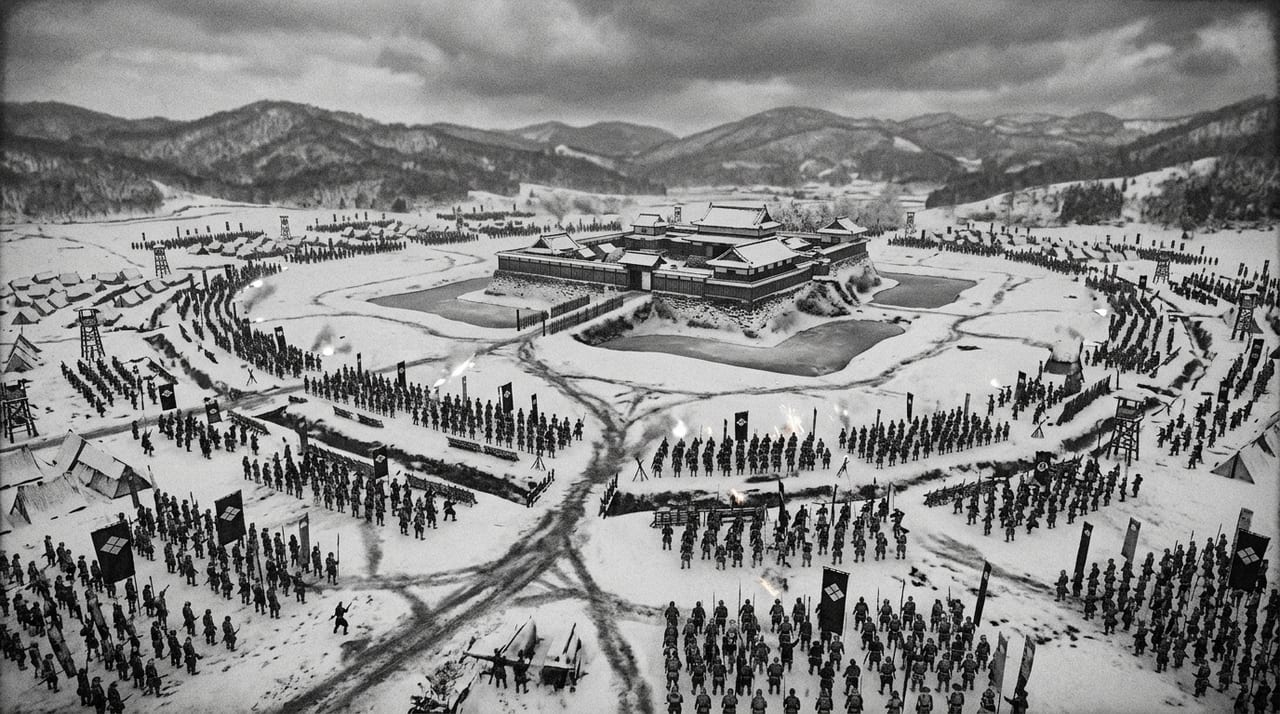
Azuchi-Schloss war die Festung, die Oda Nobunaga zwischen 1576 und 1579 (Tenshō 4–7) auf dem Berg Azuchi im Bezirk Gamō der Provinz Ōmi (heutiges Azuchi-chō, Stadt Ōmi-Hachiman, Präfektur Shiga) erbaute. Mit einer durchgehend steinernen Wallanlage, einem beispiellosen mehrstöckigen tenshu-Bergfried, Innenraumdekorationen des Malers Kanō Eitoku und einer Freihandelsstadt unter der Burg kehrte Azuchi die bis dahin geltenden Konventionen der japanischen Burgarchitektur um. Obwohl es kurz nach dem Honnō-ji-Zwischenfall von 1582 in Flammen aufging, steht es als die Schlüsselstruktur, die den Verlauf des japanischen Burgbaus für Jahrhunderte prägen sollte.
Der Berg Azuchi beherbergte einst eine Satellitenfestung der Kannonji-Burg, des Sitzes des Ōmi-shugo-Clans Rokkaku, und seine Lage am See Biwa machte ihn zu einem strategischen Knotenpunkt, der Kyoto mit den östlichen Provinzen verband. Nachdem Nobunaga Takeda Katsuyori in der Schlacht von Nagashino 1575 besiegt und seine Kontrolle über die Kinai-Region und darüber hinaus gefestigt hatte, brauchte er einen neuen Hauptsitz, der seiner Kampagne zur Einigung Japans entsprechen würde, einen, der seine bisherige Basis auf Gifu-Schloss überträfe. Die Wassertransportrouten des Sees und die beherrschende Aussicht über Kyoto und die östlichen Provinzen führten dazu, dass Nobunaga den Berg Azuchi für seine neue Burg auswählte.
Im 1. Monat von Tenshō 4 (1576) ernannte Nobunaga seinen hochrangigen Gefolgsmann Niwa Nagahide zum Generalbaumeister und begann mit dem Bau von Azuchi-Schloss. Hashiba Hideyoshi soll an der Planung des Burglayouts teilgenommen haben, die Anō-shū — eine in Ōmi ansässige Zunft von Steinmetzen — führte die Steinarbeiten durch, und Okabe Matauemon war Obermeister der Zimmerleute, die die hölzernen Strukturen einschließlich des tenshu überwachten. Das riesige Projekt, das Vasallen und Handwerker aus vielen Provinzen mobilisierte, wurde mehrere Jahre lang fortgesetzt, und am 11. Tag des 5. Monats von Tenshō 7 (1579) erlebte der vollendete tenshu seinen Einzug mit Nobunaga selbst als Bewohner. Eine Bauzeit von etwa dreieinhalb Jahren vom Spatenstich bis zur Vollendung des tenshu stellte ein Projekt außergewöhnlicher Größe und Geschwindigkeit für seine Zeit dar.
Der tenshu von Azuchi-Schloss wird beschrieben als in bōrō-gata-Stil (Wachtturmstil) errichtet, mit sechs oberirdischen Geschossen und einem unterirdischen, von außen fünf Ebenen zeigend. Zeitgenössische Aufzeichnungen geben seine Höhe mit "sechzehn ken" an (ungefähr 32 Meter), und er gilt als der erste tenshu dieser Größe in der Geschichte der japanischen Burgarchitektur. Während frühere Burgtürme einen stark defensiven Charakter bewahrten, trug der tenshu in Azuchi stattdessen eine deutlich symbolische Funktion: er projizierte Autorität und Größe. Ihm wird die Schaffung des Prototyps für die tenshu der späteren frühen modernen japanischen Burgen zugeschrieben — Strukturen, die gleichzeitig defensive Bollwerke und Mittel zur Visualisierung der Autorität eines Herrschers waren.
Eines der beeindruckendsten Merkmale von Azuchi-Schloss war die Verwendung einer durchgehend steinernen Wallanlage, die den gesamten Burgkomplex umgab. Die Steinarbeiten sollen von der Anō-shū, einer in Sakamoto in Ōmi ansässigen Maurerzunft, durchgeführt worden sein, und dieses Projekt wurde zu einer der Quellen der Steinmauer-Bautechniken, die später bei frühen modernen Burgen in ganz Japan verwendet wurden. Der Innenraum des tenshu soll mit bemalten Wandschirmen des führenden Malers seiner Zeit, Kanō Eitoku, und seinem Atelier verziert worden sein — was einen völlig neuen Standard der Innenraumdekorationen in der Burgarchitektur brachte. Ausgrabungen haben auch Dachziegel enthüllt, die mit Blattgold beschichtet sind, sowie Ziegel mit dem Chrysanthemenwappen, was die außergewöhnliche dekorative Aufmerksamkeit belegt, die sogar auf die Bedachung verwendet wurde. Die Hauptzufahrtsstraße, ungefähr sechs Meter breit und 180 Meter lang, wurde fast vollkommen gerade angelegt — ein Layout, das nicht nur Verteidigungszwecke diente, sondern auch ein politisches Ziel verfolgte und Nobunagas Autorität bei Gefolgsleuten und Besuchern visuell Eindruck machte.
Unterhalb der Burg führte Nobunaga ein rakuichi-rakuza-System ein, das Kaufleuten und Handwerkern erlaubte, frei Geschäfte zu treiben, mit Privilegien wie der Befreiung von verschiedenen Abgaben, um den Wohlstand der Stadt zu fördern. Er stärkte auch Azuchis Rolle als Verkehrs- und Handelsknotenpunkt, indem er Kaufleute auf der Nakasendō-Straße zwang, eine Nacht in der Burgstadt zu verbringen. Durch solche Wirtschaftspolitik wuchs die Stadt unter Azuchi-Schloss zu einer volkreichen Siedlung heran — ein Beweis, dass Nobunaga die Burg nicht bloß als militärische Festung, sondern als zusammengesetztes Zentrum von Politik, Wirtschaft und Kultur konzipierte.
Im 6. Monat von Tenshō 10 (1582) starb Nobunaga einen gewaltsamen Tod im Honnō-ji in Kyoto, verraten von seinem hochrangigen Gefolgsmann Akechi Mitsuhide, in einem Ereignis, das als Honnō-ji-Zwischenfall bekannt wurde. Gamō Katahide, der Azuchi-Schloss kommandierte, evakuierte Nobunagas Frau und Kinder zur Basis des Gamō-Clans auf Hino-Schloss und zog sich zurück, woraufhin Akechi-Kräfte Azuchi besetzten. Als Mitsuhide von Hashiba Hideyoshi in der Schlacht von Yamazaki später im selben Monat besiegt wurde, brannten der tenshu und die Gebäude des honmaru um jene Zeit ab. Mehrere Theorien sind über die Brandursache vorgeschlagen worden — Blitzschlag, Brandstiftung durch die Seite Akechi oder Oda, oder Plünderungen und zufälliges Feuer inmitten des Chaos — aber keine ist bis heute schlüssig festgestellt worden. Heute bleiben nur die steinernen Wallanlagen und Grundsteine auf der Stätte von Azuchi-Schloss; sie wurde 1952 zum nationalen Spezialhistorischen Ort ernannt, und Ausgrabungs- und Erhaltungsarbeiten dauern dort an.
Trotz nur knapp drei Jahren Bestehen war Azuchi-Schloss die Schlüsselstruktur, die den Verlauf der japanischen frühen modernen Burgarchitektur für ungefähr die nächsten drei Jahrhunderte prägte. Seine solide, durchgehend steinerne Konstruktion; die Konzeption eines aufragenden Bergfrieds, der gleichzeitig eine defensive Festung und ein Symbol der Autorität war; eine Kultur der Dekoration von Innenräumen mit feinen Gemälden; und eine Wirtschaftspolitik, die die Burg mit einer blühenden Stadt unter ihr integrierte — all dies wurde zuerst in vollständiger Form in Azuchi zusammengebracht und in die Burgen weitergegeben, die folgten, von Toyotomi Hideyoshis Osaka-Schloss und Jurakudai bis zum Edo-Schloss und den vielen frühen modernen Burgen, die unter der Tokugawa in ganz Japan errichtet wurden. Obwohl das Feuer, das es vernichtete, bedeutet, dass der ursprüngliche tenshu heute nie gesehen werden kann, wird die neue Vision der Burg als Struktur, die gesehen werden soll und beeindrucken soll — eine, die Azuchi zuerst verkörperte — weiterhin als einer der großen Wendepunkte in der Geschichte der japanischen Burgarchitektur betrachtet.